
Supporting Student Need
Mo’s Cupboard Team
“Without basic needs of food, housing, and stability being met, it is unrealistic and impractical to have the ability to focus on school.”
Student need on college campuses is a growing crisis across the nation. According to the Hope Center for Student Basic Needs at the Lewis Katz School of Medicine at Temple University, three in five college students do not have enough to eat or a safe, consistent place to live.
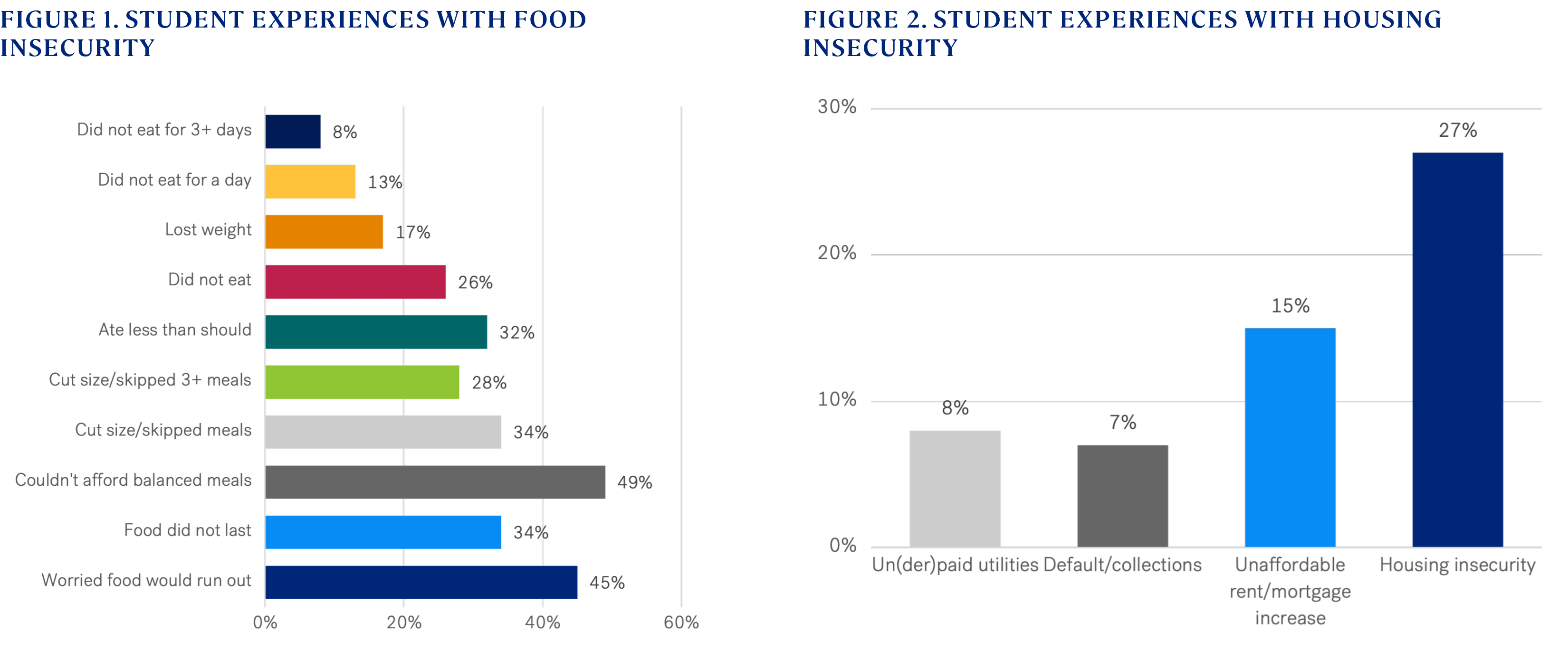
Student need at Moravian University is nearly as dire. The Hope Center polled a random sampling of 239 Moravian students in spring 2025 via email. They found nearly 50 percent of respondents were experiencing at least one basic need insecurity, ranging from food insecurity to housing insecurity and homelessness. They discovered:
- Over 41 percent of respondents experienced low or very low food security, meaning they have limited or uncertain availability of nutritionally adequate and safe food, according to the United States Department of Agriculture. (see Figure 1)
- More than one in four respondents experienced at least one challenge that prevented them from having a consistent and affordable place to live in the previous year. (see Figure 2)
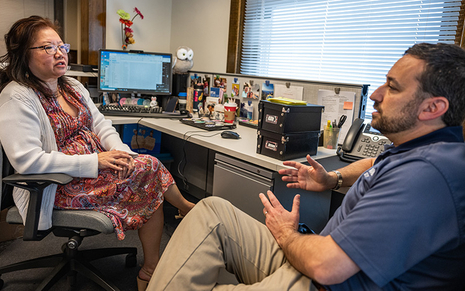
But what is different at Moravian is the resources being offered to help students offset their needs. Greg Meyer, dean for community wellness, Aileen Thompson, community support coordinator, and In-Chi Chow-Rivera P’24, P’26, executive administrative assistant for student life, are behind these resources and empowering students to stay in college, gain access to what they need to be well, and succeed.
“I see a lot of students who have challenges and barriers to both physiological needs and safety needs, which sometimes can impact their mental health. Without basic needs of food, housing, and stability being met, it is unrealistic and impractical to have the ability to focus on school,” Aileen explains. “Ultimately, in rare and unfortunate circumstances, some students decide to take a leave of absence to focus on their mental health and basic needs in order to come back in another semester.”
“Without basic needs of food, housing, and stability being met, it is unrealistic and impractical to have the ability to focus on school,” Aileen says.
Last year, the team worked with campus partners to develop the Helping Hounds Student Fund, which provides flexible aid to support students. Contributions support further initiatives on campus, like Mo’s Cupboard, Moravian’s on-campus food and resource pantry, and Mo’s Fund, targeted support for students experiencing emergencies and hardship. While initiatives like Mo’s Cupboard and Mo’s Fund have existed for years, the Helping Hounds Student Fund gives Greg and his team the flexibility to use the unrestricted funds to help students however they deem necessary.
“In the 2024–2025 academic year, we spent $18,626.69 directly on students and $3,145.56 on food and other essentials for the cupboard. We spent $10,763.49 from the Mo’s Fund budget which benefitted eight students,” Greg says. “Monetary support is the most important thing because then we can meet the variety of needs that arise. We also post some of our most-needed items on our Amazon Wishlist, which usually includes toiletries and cleaning supplies. We also can always use volunteers, so if people have time they want to give, they should reach out.”
Student use of Mo’s Cupboard has also skyrocketed since its inception. In 2018, the pantry helped 22 students; just last year, it supported 1,168 students—which is also nearly twice the number during the 2023–2024 academic year.
“We have extremely resilient and determined students here [at Moravian]. With the support of Mo’s Cupboard, assisting in meeting basic needs, and with the support of family and friends, these students receive the higher basic needs of love, belonging, self-esteem, and self-actualization,” Aileen says.
