
Full Circle
After growing up in Northeast Philadelphia, Melissa Marazas ‘13 came to Moravian University for her undergraduate education, returned to Philadelphia to teach, and heads to Spain this fall for a Fulbright scholarship, following a path that ultimately leads to home.
By Megan Othersen Gorman
If you were to take a compass—the kind you might use in geometry class—and a map, plant the needle precisely where Melissa Marazas grew up in Northeast Philadelphia, and then draw a circle around her life as she shaped it in her 26 years, the circle would be relatively small, maybe the size of a bottle cap, depending on the scale of your map. She’s visited dozens of states, and she traveled to India twice for a pair of educational projects, the first time while she was at Moravian. But otherwise, Marazas purposefully stayed close to home—until now. In September, the first-grade teacher at the Westwood School, a small, private school in Philadelphia, will travel to Spain on a nearly yearlong Fulbright scholarship to teach at the Universidad Camilo José Cela in Madrid—an ocean away from Philly.
Marazas’s circle—a globe, really—just got a lot bigger.
We met at a sunny sidewalk café near her home in the Manayunk section of Philadelphia, a parade ground for hip, Spandex-clad twentysomethings, not unlike Marazas. “It was my dream to go to college, become a teacher, and come back and work in Philly,” she says. “Growing up, I had really powerful educators and coaches, and I wanted to be what they were for me for someone else. I wanted to inspire children to teach.”
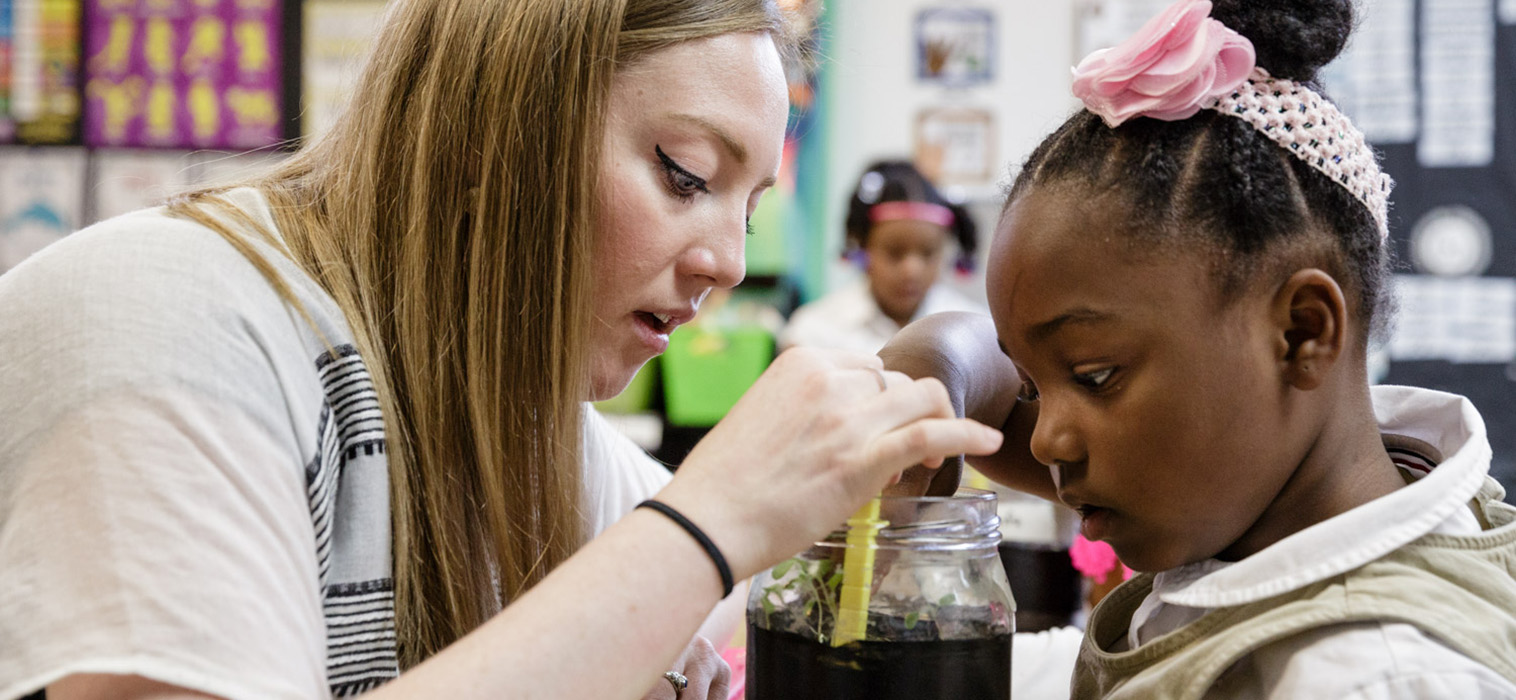
Marazas is the first in her family to go to college. So while dreams are never guaranteed, hers was definitely a reach. She admits she ended up at Moravian by chance. “Some high school friends were visiting a few colleges in the area—Muhlenberg, Lafayette, Albright, and Moravian,” she says, “and I just tagged along.”
She fell hard for the Moravian campus. “I felt at home there,” she says, “right from the start. I did my research later and fell in love with Moravian’s education program. But if I’m honest, I picked the school first, then the program.” Yet it was her third Moravian love—the faculty, and especially the female faculty—that turned out to be the most enduring.
There was John Black: “My advisor,” she says, head cocked in thought, smile wide.
Naomi Gal: “She was part of my Moravian experience from the get-go. She works in the religion department, but I took an English class with her. She was very soft-spoken and super-inspiring. I think of her still.”
And Nicole Tabor in the English department: “She has always been a very inspiring womanly figure for me. She always spoke to us as though we had loads of experience. She always encouraged us to own our expertise, and I think that motivated many of her students, myself included, to take initiative. I use the same language she used now, in my classroom.”
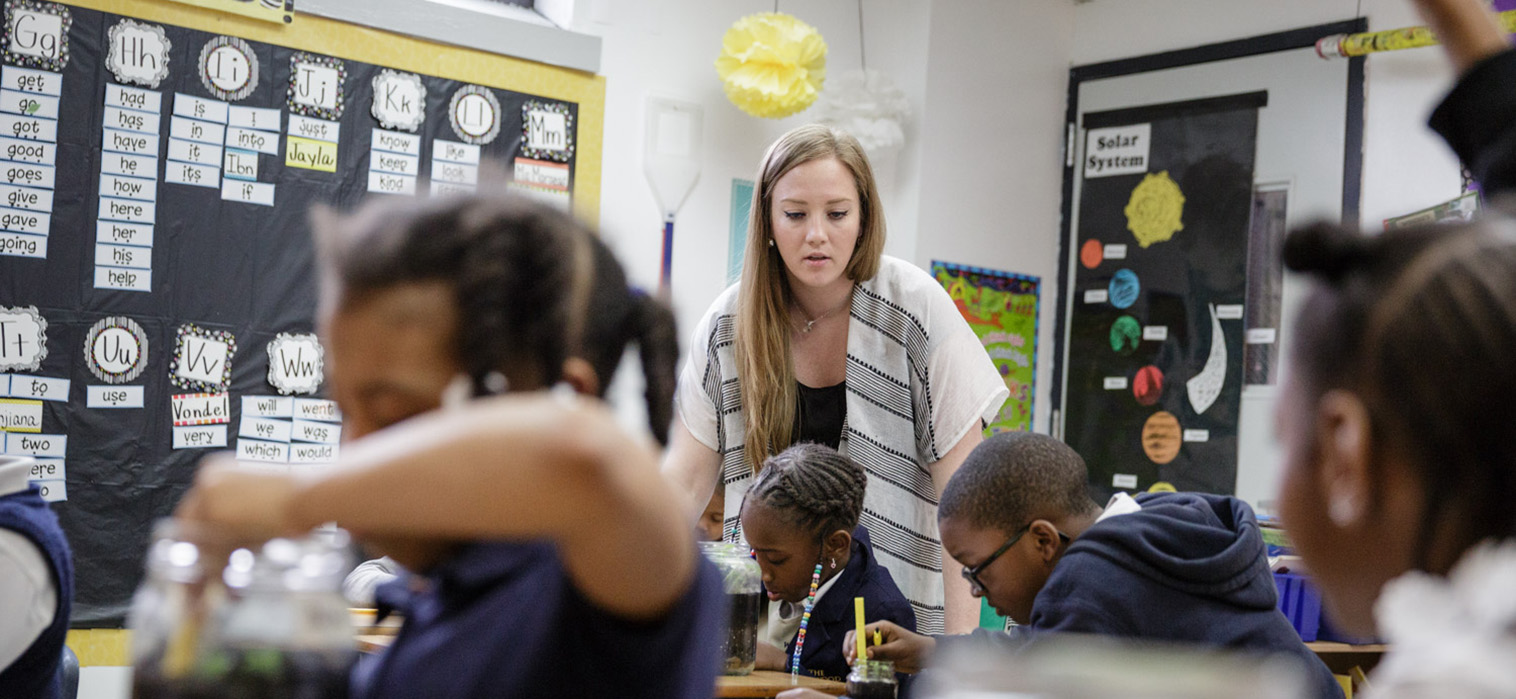
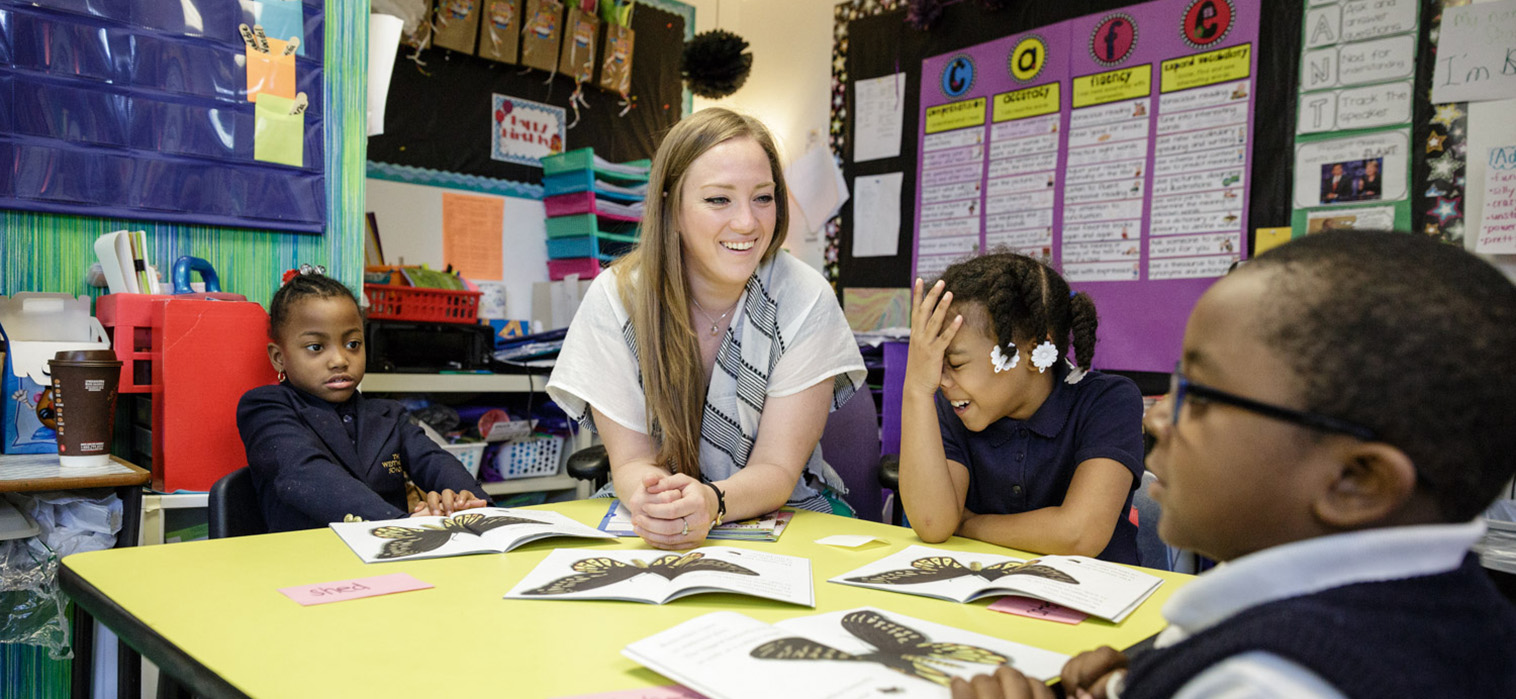
Marazas’s classroom at the Westwood School is home to 13 first graders and a beloved poster outlining behavioral expectations that has followed Marazas from classroom to classroom throughout her teaching career. On it, the letters S-L-A-N-T are printed vertically and defined: S stands for sit up. L is for listen. A is ask questions. N is nod for understanding. And T is track the speaker. After every desired behavior is a picture of President Barack Obama, the ultimate expert, sitting up straight, listening, asking questions—the works.
“I felt at home there right from the start. I did my research later and fell in love with Moravian’s education program. But if I’m honest, I picked the school first, then the program.”
“Dr. Tabor used to refer to us ‘experts’ all the time,” recalls Marazas. “She’d say, ‘You read this, you studied this—you’re the experts.’ I use that same language now with my first graders, and they eat it up, just as I did when I was at Moravian. It’s funny how a 20-year-old and 6-year-old can respond in the same way to the same thing. It’s evidently a human thing.”
Human connection—or our essential sameness—is a theme that runs like a line through Marazas’s teaching and through her life path. At the Westwood School, where her students are mostly African American and multicultural, she integrates different cultures and religions into every facet of her teaching. “The goal,” she says, “is to bridge the gap between cultures early by learning about them and talking about them.”
This is, of course, the very goal of the Fulbright Program. But it isn’t new to Marazas.
While at Moravian, she traveled to India through SOAR (Student Opportunity for Academic Research), cofacilitating an art program for middle school students, none of whom spoke English. “I was definitely a fish out of water,” she says with obvious understatement. “But through that experience, I learned what it means to be in the minority, to look different.” Six months later, postgraduation, Marazas joined Teach for America. At her first school in urban Philadelphia, 75 percent of her students were economically disadvantaged; all were African American. “They didn’t look like me,” says Marazas. “Their histories weren’t anything like mine. But in our classroom, I always felt right at home—and that was a wonderful thing to learn.
“I think about my experience in India and how I processed it,” she says, “and my experiences in Teach for America and how I processed them, and I think they led me, somewhat circuitously, to Spain. It wasn’t purposeful. It was organic. I grew toward it.”
The seed of the idea—the Fulbright idea—was planted at Moravian by Christie Gilson, who used to be in the education department. She had done a Fulbright in China and mentioned it as, Marazus recalls, “a really cool option.” “It stuck with me,” she says. “As you get older, you develop more ties to an area, more reasons to stay. But as I finally, at 25, tiptoed into the application process, I got more invested.”
She targeted Spain. Not because she knows Spanish—“I have just a little bit of the language, so that’s going to be a learning curve”—but for a host of reasons, not the least of which is what she perceives might be the “essential sameness” of urban Philadelphians and Spaniards at this very particular moment in time.
“I knew Spain had recently endured an economic crisis, and I felt as though there might be parallels between their situation and those of my students in Philadelphia,” says Marazas. “I thought I might have something to share.” And that’s the whole point, isn’t it?
Two things her students have taught her:
To listen—really listen. “I can’t listen intently to all my kids all the time—they’ll be telling me about their dog or their cat or some crazy thing they found in the trash can the day before. But it is a gift to be listened to, no matter what your age. And they have helped me to listen mindfully— most of the time.”
To speak up. “Kids will also be the first people to tell you when they don’t like something or don’t agree with something. They can advocate quite well for themselves when they’re given the opportunity— and that happens to be a personal goal of mine, as well—to have more of a voice, especially in times of conflict. I’m learning, and they have helped me in that process.”