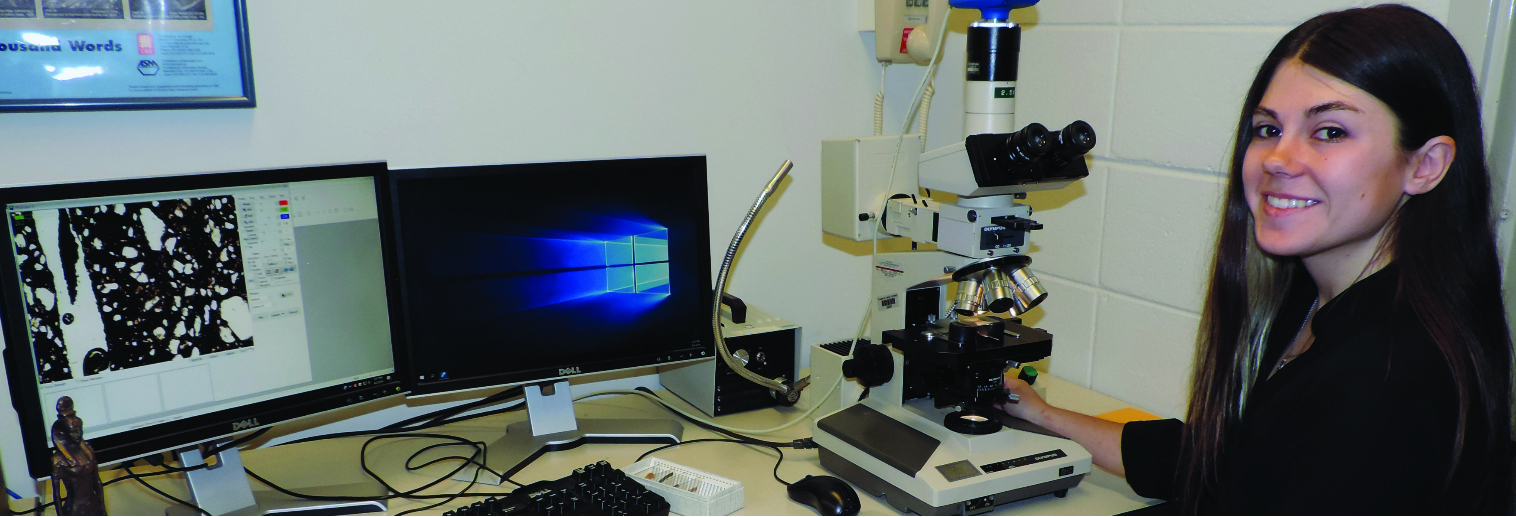
Chelsea KAUFMAn '15
Doctoral student in Egyptian art and archaeology at Johns Hopkins
Hometown: Hellertown, PA
At the age of 4, Chelsea Kaufman ’15 wanted to be a paleontologist, and by the time she turned 7, she dreamed of becoming an Egyptologist, but she would have to rediscover that foundational passion. “I was really good in art throughout school, and I liked it, so I majored in studio art, but I didn’t see it as something I wanted to make a career of,” Kaufman says. “So I focused on art history and found it a good avenue to get back to archaeology.”
In her junior year at Moravian College, Kaufman began studying anthropological archaeology with Lehigh University Professor of Anthropology Cameron Wesson. Together they worked on a prehistoric rock shelter site in Mertztown, PA, mapped the foundation of the Moravian First House in Nazareth, and worked on a Bronze Age site in the Hebrides. Last summer, Kaufman ran an excavation for Wesson at the George Taylor house in Catasauqua, PA.
After graduating from Moravian, Kaufman earned her master of arts in archaeology at Yale, where her thesis focused on petrographic analysis of ceramic thin sections from a 4th-millennium-BCE site in Upper Egypt to determine which cultures may have contributed to the state of Egypt. While at Yale, she served as the acting collections curator for the Yale Babylonian Collection.
“My studio art background has given me the insight and appreciation for the individual artist in the ancient past.”
Then it was on to Temple University, where Kaufman began pursuing a doctorate in anthropology with a concentration in archaeology, but, desiring to specialize in Egyptian art and archaeology, she will pursue her PhD at Johns Hopkins starting this fall. “I am interested in the change and consistency of art over time in both sacred and secular spaces,” Kaufman says, “especially during the 18th Dynasty, which is regarded as a period of increased trade of materials and ideas.”
Though Kaufman’s course is set on archaeological exploration and discovery, her experience as a fine artist informs her work. “My studio art background has given me the insight and appreciation for the individual artist in the ancient past,” Kaufman explains. “The individual is often the first element of the past to be lost, and so it’s important to me to seek out that individual through what remains, the objects that person has produced, in a very specific context.”