
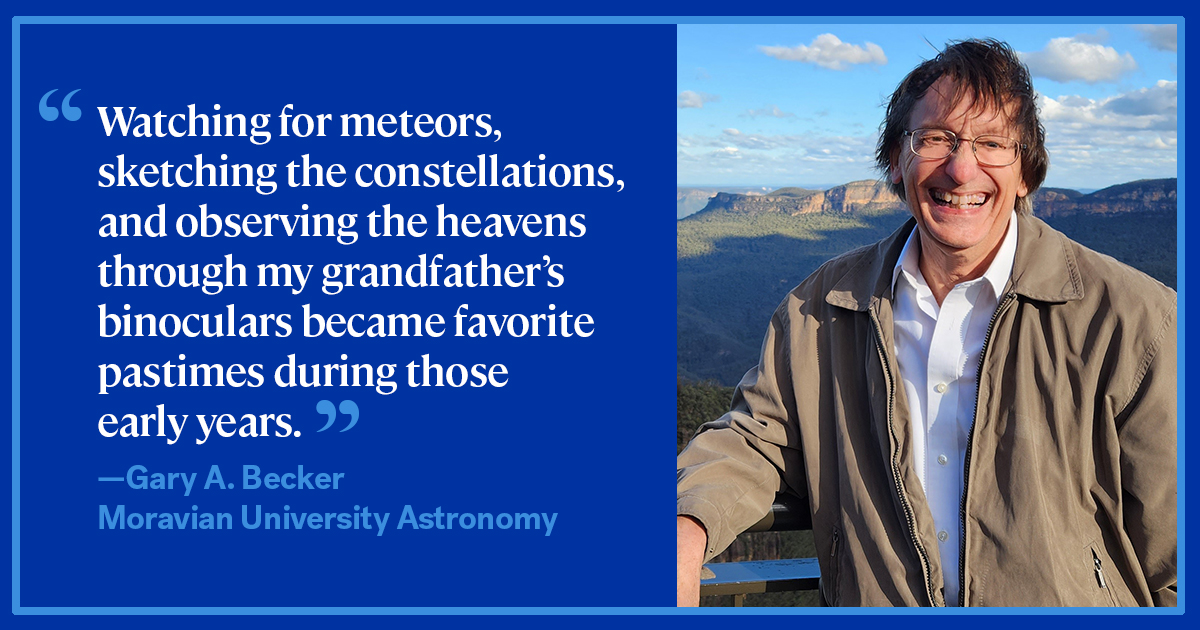
 Photo courtesy of Gary A. Becker
Guest Lecture
Perseids to Sizzle This August
When I was a kid, money was tight but looking up at the sky was free. Watching for meteors, sketching the constellations, and observing the heavens through my grandfather’s binoculars became favorite pastimes during those early years. This eventually led to a career in astronomy education, first in the Allentown School District Planetarium for 38 years and presently at Moravian University, where I will start my 14th year of instruction this coming fall semester. Without a doubt, it was the Perseid meteor shower that inspired my serious career interests in astronomy and my first scientific observations of the night sky.
The Perseids Explained
As comets orbit the sun, they leave behind a trail of dust and gasses. If Earth passes through one of these trails, the dross can enter Earth’s atmosphere. Once there, it rapidly disintegrates, causing a column of air to glow around it, which creates the meteor or shooting star phenomenon. The Perseids originate from Comet 109P/Swift-Tuttle, which was last seen in 1992. The point in the sky from which the Perseids appear to originate is the constellation of Perseus; hence the name of this meteor shower.
Viewing the Perseid Meteor Shower
Saturday morning through Monday morning, August 12 through 14, will present a wonderful opportunity to view the 2023 Perseid meteor shower.
Meteor showers are not meteor storms, so don’t expect to see shooting stars every second or two. Often Perseids occur in bunches. You might catch two or three in a minute’s worth of observation and then not see any for several minutes. In Montana in 2016, I saw six Perseids in a 15-second interval followed by a period of 10 minutes of inactivity. So don’t become disappointed if you hit a lull; you will see many Perseids if you are persistent.
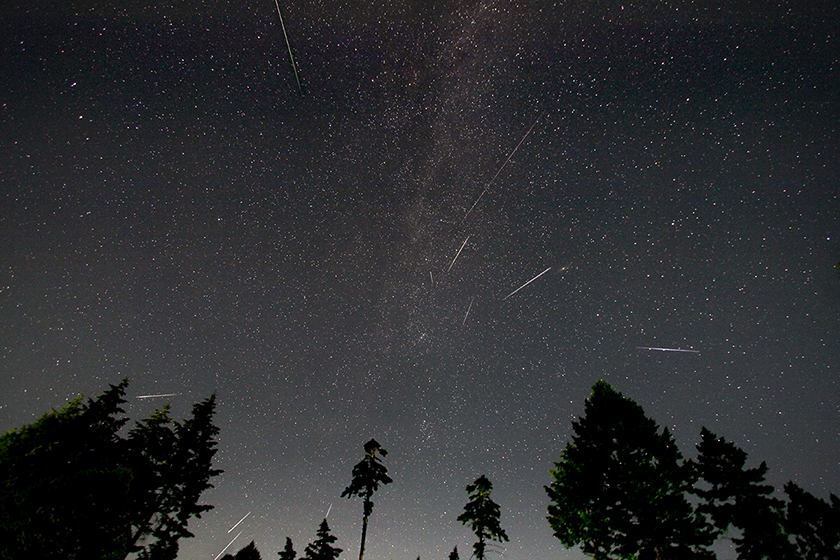
The shore of Flathead Lake in northwestern Montana was the setting for this composite image by the author,
which records the brightest meteors seen on the night of August 14, 2016, a day after Perseid maximum.
Tips for the Best Viewing
The most critical factor when looking for shooting stars is the darkness of your observation location. Watching from the Sky Deck at Moravian University in Bethlehem, you may see five Perseids per hour. From a dark location like Cherry Springs State Park, Pennsylvania’s dark-sky observation site near Coudersport, you may see as many as one meteor per minute.
Regardless of your locality, you’ll see the most Perseids by looking toward the zenith—the highest point of the sky, which is generally the darkest region of the heavens. All meteors that are part of an organized group move through the sky from an origin point, which is called the radiant. Before midnight, that position will be low in the northeast, so Perseid meteors will appear to be spraying outward from a location near the horizon. As the night progresses, the rate of seeing Perseids will increase as Earth’s rotation moves the radiant higher in the sky. You’ll then be catching meteors from both above and below the radiant. In addition, after midnight, Earth plows into the meteoroid debris, similarly to the front windshield of a moving vehicle getting splattered by more raindrops than the rear window.
Many astronomy enthusiasts call the Perseids the best shooting star event of the year although it does not produce the highest number of meteor counts. For that, try the Geminids in frigid December. The Perseid meteor shower, however, combines relatively high rates of meteor counts with warm summer nights when many families are on vacation, including camping trips away from city lights.
Whether you are one of these folks or simply curious to see a meteor event, spend a few hours viewing the dark sky between midnight and dawn on Sunday morning, August 13, when Perseid rates are predicted to be at their highest. Much success in your Perseid hunting. Ad Astra!