
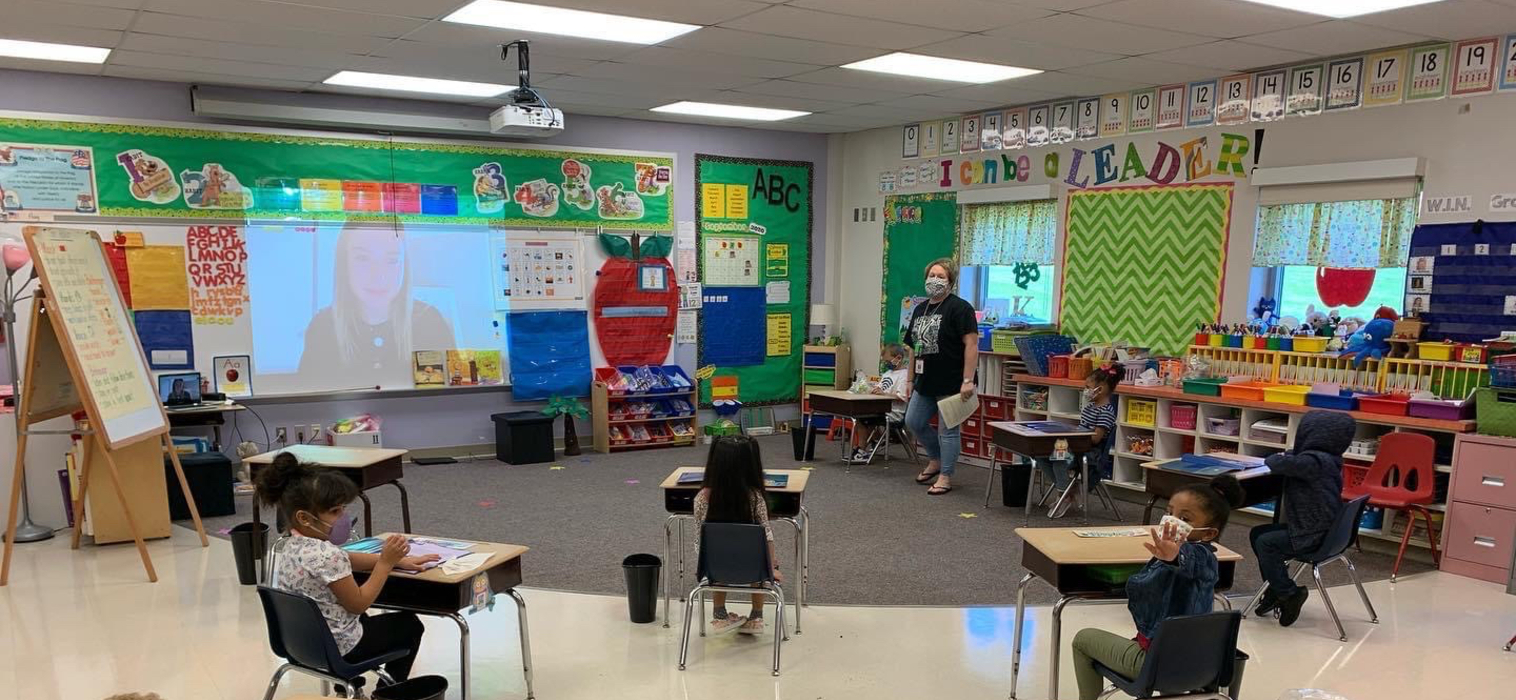
Stephanie McKinnon’s kindergarten classroom at Marvine Elementary School in Bethlehem.
Innovators in Early Childhood Education
Brooke Granitz ’20 and kindergarten teacher Stephanie McKinnon have devised creative solutions to online student teaching.
By Meghan Decker Szvetecz ’08
How do you train as a student teacher when you’re not physically in the classroom? That’s the challenge early childhood education major Brooke Granitz ’20 and all of the other future teachers have had to figure out amid the pandemic. Though it was not what she had envisioned for her student-teaching experience, Granitz was hardly discouraged when it was announced that the Bethlehem Area School District would not be accepting student teachers for in-class teaching. “I’ve wanted to be a teacher all my life,” Granitz says. “There’s no way this is going to stop me. I am happy to adjust.”
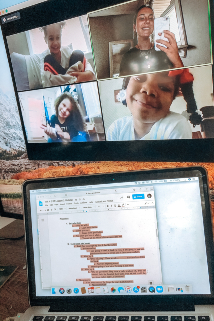
Student teacher Brooke Granitz ’20
works with students online.
Rewriting the Plan
Given the Marvine Elementary School hybrid schedule—two days in-school instruction, two days online learning—Granitz’s only opportunity to physically work alongside kindergarten teacher Stephanie McKinnon is during their Monday planning days. Granitz and McKinnon spend the morning planning and “rewriting the plan” for the week’s lessons, McKinnon says, then spend the afternoon checking in with parents to answer questions or offer tech support.
“We have to be in the same space because there are just too many materials to show Brooke, too many things to talk about,” says McKinnon. It’s hard enough trying to figure out how to use her virtually, and without that planning time together I think it would be impossible.”
On days designated for in-person instruction, McKinnon sets Granitz up on her laptop or on the large projection screen and Granitz logs in from her home in Moore Township. Granitz quietly observes the classroom and then waits for McKinnon to call students over to the screen one by one to practice reading. Granitz, who is hearing impaired, actually benefits from this arrangement, because students can safely pull down their masks so Granitz can read their lips and then pull up their masks before returning to their desks. “If I were in the classroom, it would definitely be a struggle with their masks on,” she says.

Story Time with Miss Granitz
McKinnon and Granitz are constantly refining their methods for seamless instruction to find what works for everyone. When they realized that only a few parents were available at the times Granitz was presenting social studies lessons via video conferencing, the pair replaced their plan for live virtual instruction with videos of Granitz reading books that serve as a supplement to the reading curriculum. McKinnon added a link to her Google Classroom called “Story Time with Miss Granitz,” and now students can listen to the stories at their convenience, as often as they’d like. “Every week I consider what else we could do and how we could do it differently,” McKinnon says.
Each virtual lesson or book video is recorded and sent to McKinnon so she can provide feedback to Granitz. “She wants to see every video, and I’m so grateful that she’s putting in that time after her working hours to help me out,” Granitz says.
A drawback of teaching via video conferencing, Granitz admits, is that it’s challenging for her to gauge a student’s true understanding of a lesson when they are learning alongside their parents. On the upside, Granitz says, it provides valuable interaction with parents that she wouldn’t otherwise have in class.
Still, she is missing the key skill of managing a classroom of students. “My heart goes out to her because I’m making it work with the students and we’re adjusting expectations, but she is really missing the classroom management part of student teaching,” says McKinnon, who has been teaching for nearly 30 years. “That is where I worry, because you can get up and teach the greatest lesson, but if you don’t have that classroom management piece, nobody is going to be learning.”
Luckily for Granitz, she can draw upon her past experience as an instructor for the nonprofit enrichment program Lehigh Valley Summerbridge, which serves low-income middle school students. That experience two years ago has given Granitz confidence in her ability to handle her own classroom as she looks to begin her job hunt at the end of the year.
Navigating a New Era
Granitz is taking her final months as a student to prepare as much as possible for how to navigate this new era of learning and teaching. “With change comes challenge, and I’m open to learning it all,” she says. Granitz stays in constant conversation with her advisor, professors, and peers in the education department and shares the books, ideas, and inspiration she gathers.
As she searches to understand this acceleration of technology use with young learners, Granitz predicts what it will mean for her future career. Perhaps it will eliminate snow days and sick days. Or 15-minute lessons will be synthesized into a one-minute YouTube video allowing for more class time to apply a new skill. “I’m really trying to push myself forward, learn as much as I can, and master this way of teaching,” Granitz says.
Meghan Decker Szvetecz ’08 is a freelance writer with a background in higher education communications and lifestyle editorial. Aside from writing for her alma mater, her clients have included Gwynedd Mercy University, Lehigh Valley Style, Moravian Academy, and Northampton
Community College.