
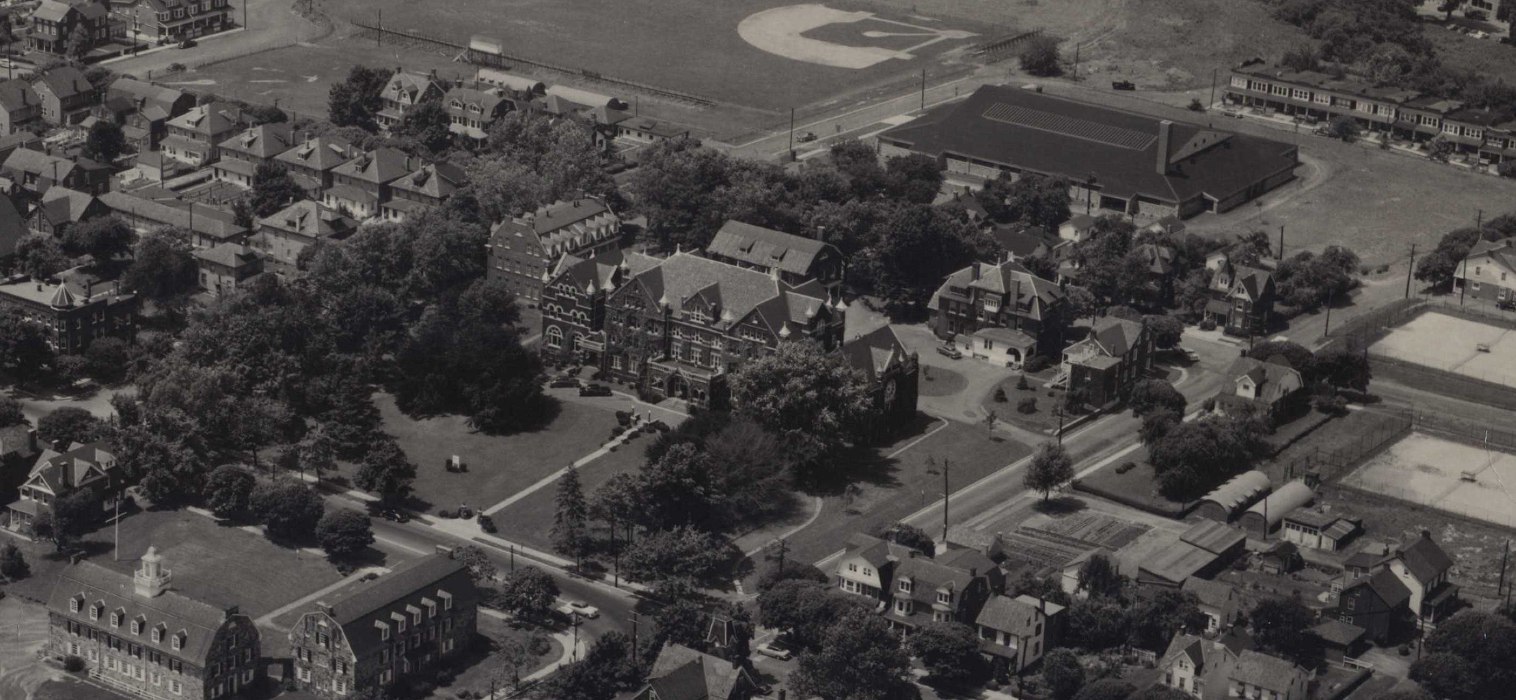
A 1950s aerial view of Moravian’s campus showing four of the huts after relocation.
Moravian Moment
Peace Dividends
By Nancy Rutman ’84
At the close of the Second World War 75 years ago, the US War Department and the US Navy Department had an inventory problem: what to do with the equipment, uniforms, and other property they had acquired for the war effort but no longer needed. Army & Navy Surplus stores were the solution for clothing and other smaller items. But what do you do when you need to dismantle an entire military base?
Enter the War Assets Administration. Established by executive order in March 1946, this agency would eventually dispose of hundreds of thousands of tons of military equipment, including tanks, aircraft, and warships. Real estate—from industrial plants to air fields—was also put on the market. Among the properties sold was Camp Peary, the Naval Construction Training Center near Williamsburg, Virginia. Between November 1942 and June 1944, when such training was relocated, more than 100,000 men had passed through the camp. It was here, in hundreds of buildings called Quonset huts, that the Construction Battalions (“Sea Bees”) responsible for building airstrips, roads, and bridges in war zones were trained. After this type of training was relocated, the camp was converted to house German prisoners of war, many from captured U-boats.
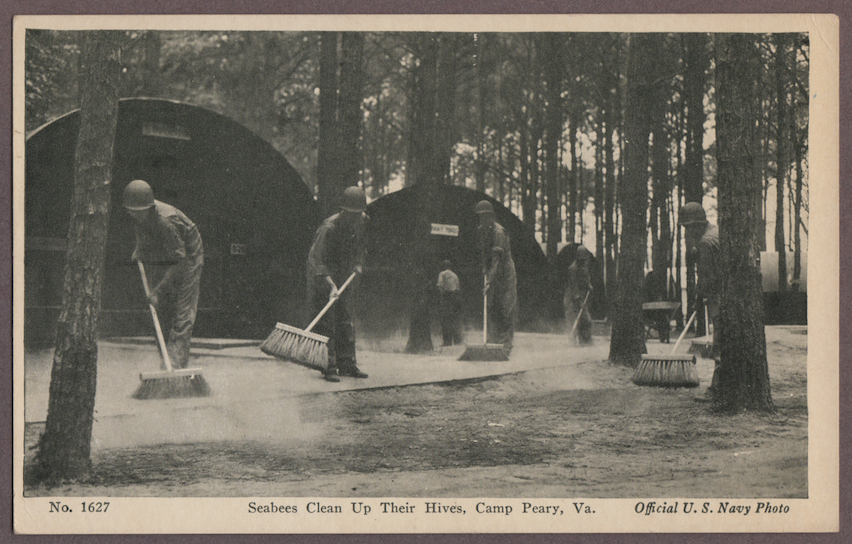
Sea Bees at Camp Peary tidying up in front of their Quonset huts.
When the US Navy vacated Camp Peary in 1946, the base’s assets were offered to government agencies such as the Federal Works Agency (FWA). In December of that year, the FWA announced that it was distributing 197 of Camp Peary’s Quonset huts throughout the Northeast, mostly to public schools, colleges, and universities. Moravian College and Theological Seminary was among the Lehigh Valley recipients.
The Quonset hut is a style of building that was popular with the military during the war because it could be shipped in prefabricated sections and assembled at lightning speed. It consists of a simple wooden frame topped by a semicircular roof, resembling a tunnel. In March 1947, the Allentown Morning Call reported that the FWA was to give Moravian four Quonset huts measuring 16 by 48 feet. Two of the buildings were to be placed behind the bleachers on the east side of the athletic field (now John Makuvek Field) and two on the west side of Mercury Street, the alley running north from Elizabeth Avenue opposite Comenius Hall. All together, they would give the college an extra 3,000 square feet of space.
These humble buildings stood on Moravian’s campus for decades, their longevity a testament to the skills
of the men who constructed them and who helped the Allies win World War II.
By August 22, 1947, the FWA had delivered the buildings to campus, and Paul E. Cunningham, then Moravian’s superintendent of buildings and grounds, supervised final installation of facilities. The two huts near the athletic field would be used to store heavy equipment, with part of one being equipped as a restroom for football spectators. One of the two huts north of Comenius hall would be used as a maintenance shop and the other for additional storage.
These humble buildings stood on Moravian’s campus for decades, their longevity a testament to the skills of the men who constructed them and who helped the Allies win World War II. The two near the athletic field were probably removed shortly before construction of the new Student (now Haupert) Union Building began in the spring of 1960. The other two buildings lasted longer; the author remembers seeing them until at least the 1990s. Their former location is now part of a college parking lot.
Moravian College Magazine would love to hear from readers who have memories of these remnants of military history on our campus.
Email us at mcmagazine@moravian.edu.