
Guest Lecture
Ideology and China’s Economic Rise
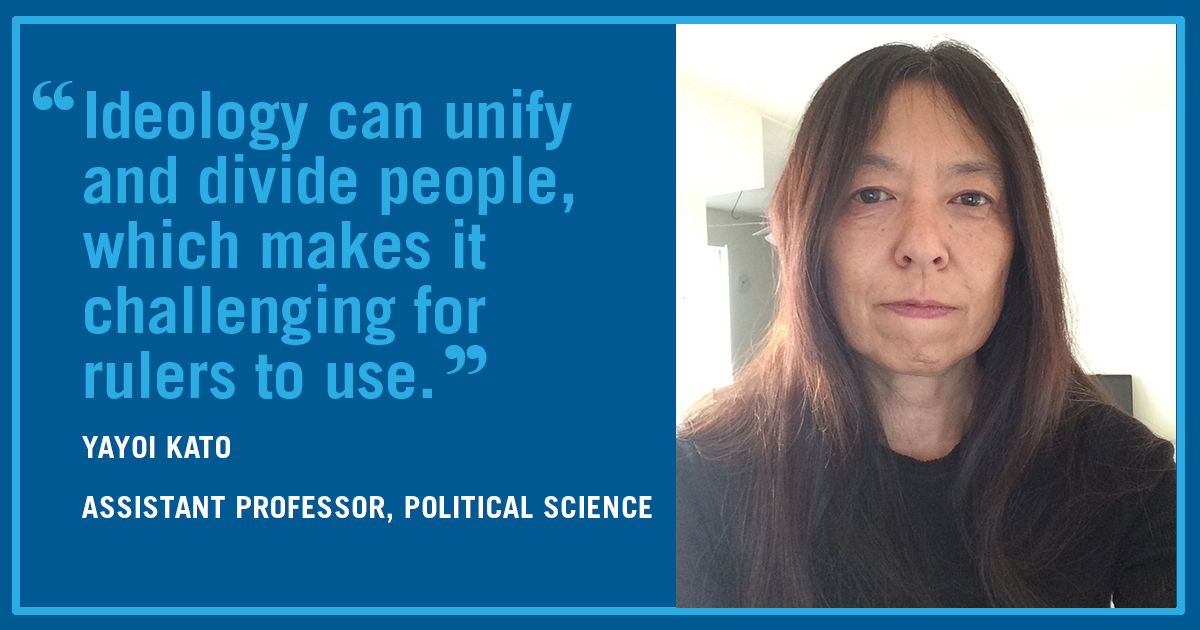
Yayoi Kato is an assistant professor of political science with a specialty in Chinese politics. Her research interests focus on the ideology and propaganda work of China’s communist party and their effects on China’s economic reforms. Her book Party Ideology, Public Discourse, and Reform Governance in China was published in March of this year. Here, Kato addresses the importance of ideology in China’s economic rise and governance.
Why has China successfully achieved such economic growth?
One of the most significant reasons was ideology. Under Chairman Mao, China was one of the poorest and most isolated countries in the world. After Mao died, the Chinese Communist Party reoriented its ideology. At the initiation of the economic reform, the second leader, Deng Xiaoping, sent a message to the Chinese people: “It doesn’t matter whether a cat is black or white, as long as it catches mice.” This message was crucial in liberating the mindset of the people who had been heavily indoctrinated under Mao. Deng’s message was simple: Make money; don’t worry about ideology. The color of a cat is a metaphor for ideological differences—notably, socialism versus capitalism—and “catching mice” means that the priority is economic development, not ideological purity. Of course, the Communist Party has never abolished socialism. However, Deng redefined party ideology and framed it as market reforms for better socialism and encouraged people to make money. Business successes make people rich and develop China’s economy. With a stronger economic foundation, China could build a superior socialism. Deng’s ideology is called “pragmatism” or officially, “socialism with Chinese characteristics,” which helped China become the second-largest economy.
“It doesn’t matter whether a cat is black or white, as long as it catches mice.” —Deng Xiaoping
What is ideology? What functions does it have?
While scholars never agree about its definition, ideology is a vital political resource for political leaders to maintain their power. By defining their visions, missions, and goals in line with policy initiatives, leaders can mobilize support, shape public opinion, and facilitate compliance with their policies as well as legitimize their rule through persuasion rather than coercion. Because ideology is such a powerful persuasion tool, how to define and frame ideology is very important for political leaders. As seen in Deng’s example, ideology affects a leader’s governing capacity, legitimacy, and the nation’s success. His or her ideology is adopted and used by politicians and the public in many aspects of politics, including policy making, public debates, and social movements. Politicians, opinion leaders, and activists frame their goals drawing on their ideology when they raise issues, persuade others, and mobilize support. In this sense, ideology is the core of political life and links the government and people regardless of democracies or authoritarian regimes. Indeed, ideology works in exactly the same way in China. Although many Americans believe that in China all decisions are made by the top leaders, contentious policy debates are going on even under President Xi Jinping. Policy process and deliberation in China are very similar to what we see in the United States. Policy makers from different groups promote their issues, persuade others, or attack opponents, drawing on ideology.
Does ideology really benefit political leaders?
My new book, Party Ideology, Public Discourse, and Reform Governance in China, examines China’s policy debates over the state-sector reform in the 1990s under Deng and in the 2010s under President Xi and analyzes how the two leaders’ ideologies were used in the debates. Deng’s pragmatic ideology was adopted by the reformist groups to promote the reform, which led to drastic policy outcomes, completely transforming the state sector. On the other hand, President Xi’s nationalist ideology—symbolized by the “Chinese Dream” slogan —was adopted by the conservative forces to limit the reform and attack reformers, which divided the policy community and resulted in limited policy outcomes. While Deng’s pragmatic ideology was skillfully framed in a way that liberates the public mind, alleviates divisions, and induces compliance with his policies, Xi’s “China Dream” was not framed in congruence with his policies and ended up reinforcing the existing division. Ideology can unify and divide people, which makes it challenging for rulers to use. It can legitimize their rule; yet it can destabilize their rule as well.