
Guest Lecture
Supply Chain and Current Disruptions
Though the global supply chain problems we’re facing seem unprecedented, they are simply greater and more visible. Supply chain disruptions and contributing factors existed years prior to the pandemic. Although we hear about the supply chain more than ever and see evidence of it on grocery store shelves, many don’t understand or misunderstand its complexities. Efforts to solve supply chain disruptions cannot be executed globally if nations work in isolation or if micro solutions are addressed without understanding the macro view (aka big picture) first and the total influences and impacts.
What is the supply chain and how did it break down?
One of the better definitions of supply chain management comes from the Cornell School of Operations Research: “design, planning, execution, control, and monitoring of supply-chain activities with the objective of creating net value, building a competitive infrastructure, leveraging worldwide logistics, synchronizing supply with demand and measuring performance globally.” Additionally, the resilience of the supply chain is critical, as we have recently experienced in the pandemic. Even with the best design, plan, control, and supply-and-demand sync, it crashed. Why?
Some of the macro issues:
- Shift in manufacturing (from domestic to overseas manufacturing, potentially to lower costs)
- Imbalance of trade, tariffs, and duties (countries preserving their interests)
- Just-in-time inventory levels (lower inventories save capital)
- Limited sourcing points of critical items (“The World Relies on one chip maker in Taiwan, Leaving Everyone Vulnerable,” Wall Street Journal, June 2021)
Some of the micro issues (US focused):
Shortages
- Drivers (who move 71 percent of US goods): We were short 61,500 drivers prepandemic and are now short 80,000. We will need 160,000 trucks by 2030, according to the American Trucking Association.
- Skilled equipment/lift operators at terminals
- Trucks: Production of new trucks is down due to chip and wood-flooring shortages.
- Chassis (used to move containers from dockside terminals): The International Trade Commission imposed countervailing and antidumping duties on Chinese chassis producers that supply the majority of frames to the United States.
- Rail capacity: railcar and crew shortages and ineffective communication of bottlenecks
- Warehouse labor: This impacts offloading and therefore getting chassis back to ports.
- Port capacities: Los Angeles/Long Beach handles 40 percent of US imports.
Constraints
- Regulations: Drivers must be 21 to drive across state lines, and there are limits on hours of service.
- Infrastructure: Forty percent of roads are in poor or mediocre condition. Regarding rail, 70 percent of passenger trains share tracks with freight trains, and critical projects are needed to complete maintenance and repairs, reduce bottlenecking, implement information technology solutions, and more (American Society of Civil Engineers 2021 Infrastructure Report Card).
“Supply chain resilience is the capacity of a supply chain to persist, adapt, or transform in the face of change.”
—Wieland and Durach, Journal of Business Logistics
The pandemic further exacerbated weaknesses in the prepandemic supply chain. Global shutdowns were coupled with panic buying, which reduced already low inventories. This was followed by unprecedented demand with the reopening and economic stimulation. Increased savings and the CARES Act drove increased levels of purchasing and capital investments. These investments ranged from home improvements and new hard goods like refrigerators and stoves to business improvements. All of this drove increased demand for container, truck, rail, and manufacturing capacity and the associated increased demand for labor just as the supply of labor was being negatively impacted by quarantines, sicknesses, home schooling, and shifts to different employment (e.g., from truckers to home contractors). After the shutdown, trucks, rail, and containers were not positioned where needed to meet shipping demands, interrupting the delivery of goods. Additionally, the high demand for products, people, and supplies triggered even higher needs for labor and fuel, which further impacted the global supply chain.
What to do now?
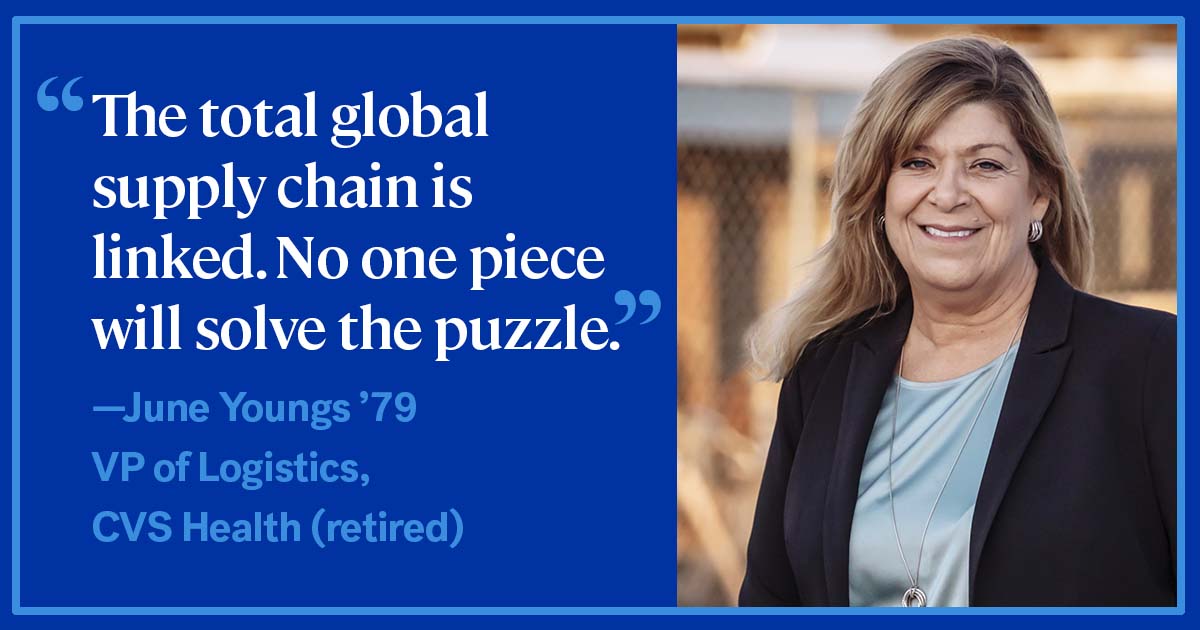
The total global supply chain is linked. No one piece will solve the puzzle. To drive immediate impacts and bring tangible results, we need to build a consortium of industry experts—from rail, trucking, labor, ocean, port, third-party logistics companies, and specialists in supply chain management—who are motivated to work together with a macro view toward micro changes (hours of service, prioritization of food and medicines, etc.) while mitigating risks and managing costs for all, holistically.
When will it be fixed?
We need to be prepared for the fact that this will take time and may not resolve into late 2022 or beyond. Optimistically, the fix is coming and clearly overdue, and the pandemic may have been the “shot in the arm” we needed for a true, functioning global supply chain and economy.
To learn more about June Youngs ’79, read "Home Run."