
Guest Lecture
The China-Africa Relationship
Over several decades, China has forged a strong relationship with Africa, which has raised concern that this may be a significant move by China toward world domination. European and Western colonization of Africa and exploitation of its resources helped facilitate this bond.
The Formation of the Africa-China Relationship
In 1955, amidst the Cold War and the decolonization of Africa, Indonesia hosted the Bandung Conference, which was attended by 29 newly independent African and Asian states. These states formed a solidarity determined not to take sides with the United States or the Soviet Union and to unite their voices into one. Chinese premier Zhou Enlai attended and spoke to the assembled states. After Bandung, China looked to the countries of Africa and helped build the TAZARA railway from Zambia to a port on the coast of Tanzania, so that Zambia could export goods.
Thirty-four years later, following the Tiananmen Square massacre in 1989 and the West’s imposition of sanctions, China pivoted toward Africa and began its heavy involvement there facilitated by Deng Xiaoping’s push for economic reform and movement away from pure communism to state capitalism. His government encouraged state-owned enterprise to go outside the country and seek markets and commodities, and they set their sights on Africa.
The Manifestation of That Relationship
Chinese-African cooperation has led to several outcomes:
Forum on China and Africa Cooperation (FOCAC). In 2000 in Beijing, FOCAC established a formal relationship between China and Africa. In 2006, a $1 billion China-Africa development fund was established, which rose to $60 billion by 2015. The money funded infrastructure projects, education, technology training, skills transfer, information, and communications.
Information communications technology (ICT). Chinese ICT companies are big players in Africa. ZTE and Huawei have developed applications and tools specifically for the African market that are accessible and affordable.
Trade. With increased cooperation also came increased trade with China, and in 2009, China became Africa’s largest trading partner. It is also the largest bilateral lender to some of Africa’s biggest economies.
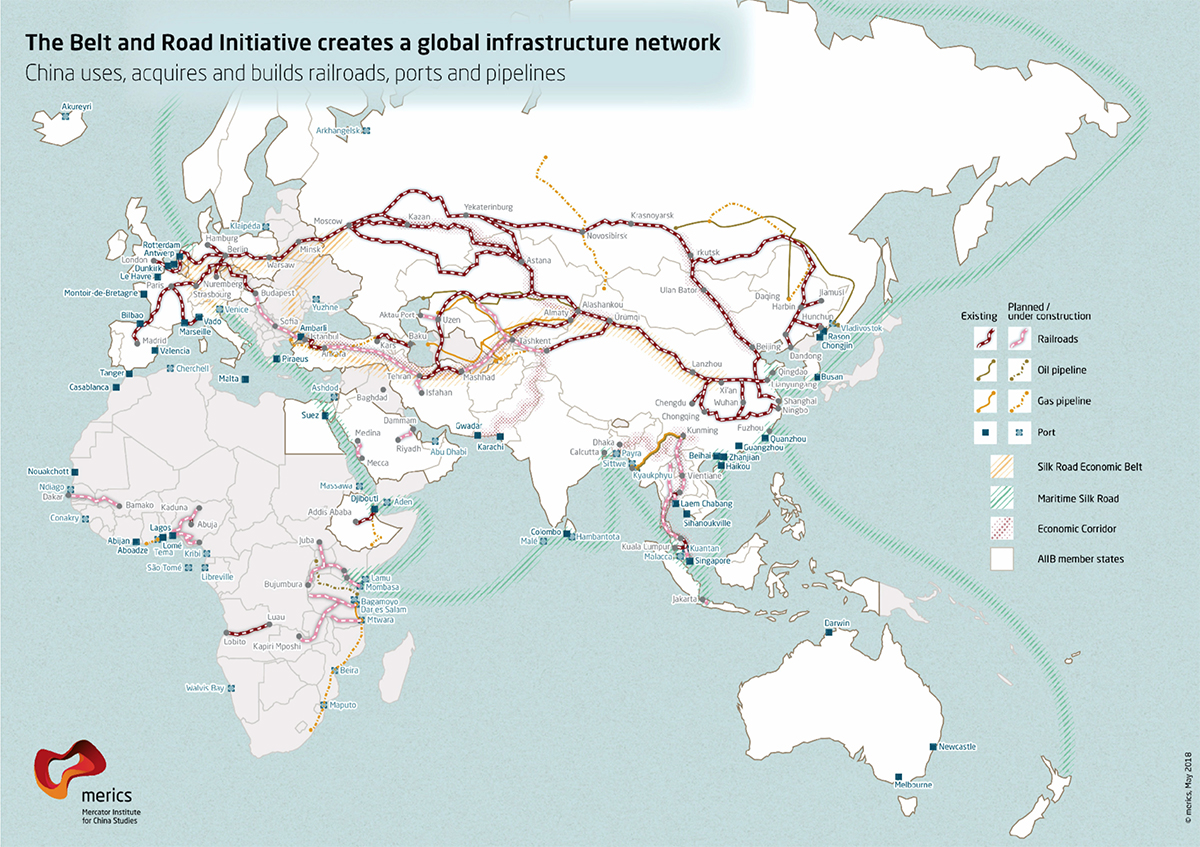
Belt and Road Initiative. This ambitious plan, launched in 2013 by President Xi Jinping, mimics and expands the old Silk Road to connect China to the rest of the world through a network of transportation infrastructure, including railways, roads, and maritime networks. When completed, it will give China unimpeded access to the world’s markets.
The Chinese streaming service Boomplay has 65 million subscribers in Africa,
which is more than all the subscribers to Apple Music all across the world.
The Chinese Approach to Foreign Policy and Power
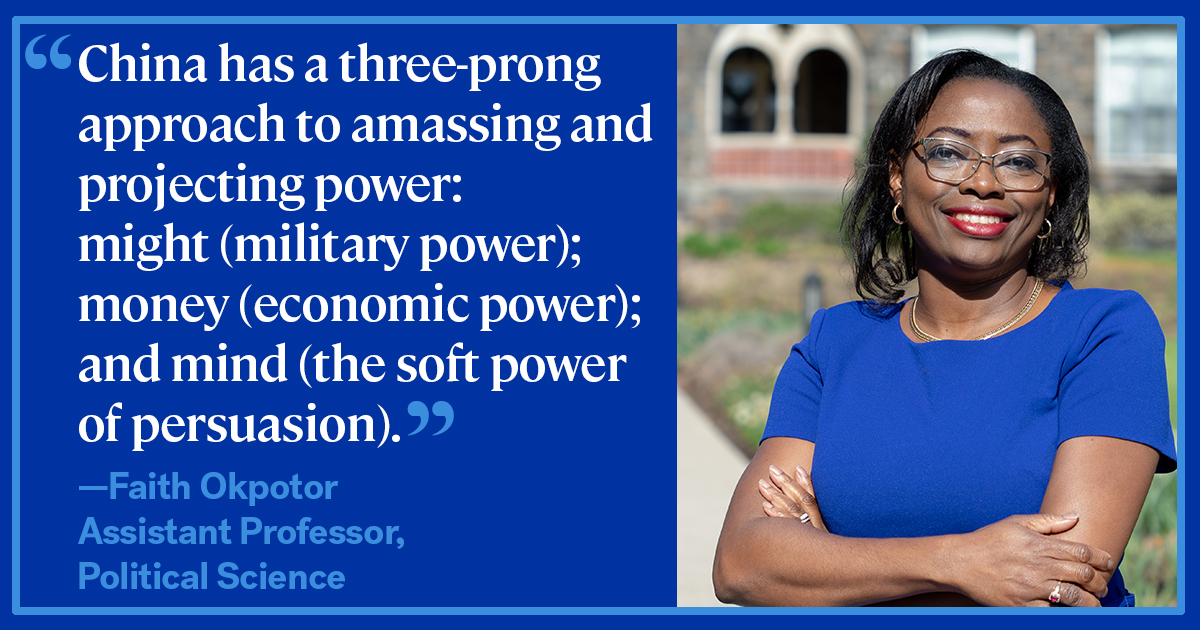
China has a three-pronged approach to amassing and projecting power: might (military power); money (economic power); and mind (the soft power of persuasion).
China is building military power to compete directly with and possibly overtake the United States as it increases its economic power and expands soft power to bring as many countries as it can into its corner. It is using its economic power to fund projects in Africa and spread good will. Chinese-African cooperation is leading to more people-to- people exchange programs and education exchanges. Lots of Africans go to China for higher education, especially since the United States, under the previous administration, made it more difficult for Africans to come to the US.
China’s approach is not merely benevolent. Its investments in Africa allow it to access some of Africa’s vital resources and huge market, while Africans get infrastructure development. Many Africans see this as a win-win situation, while others have concerns. The funding of projects in Africa comes through loans tied to stipulations. For example, China provides loans to Angola in exchange for exploration of Angolan oil. Funds for rail, roads, and buildings come with the provision that construction is handled by Chinese companies.
To advance development, China has designed a port-park-city model: build a seaport, an adjacent industrial park, and a nearby city for workers. These sites will employ cheap labor and become sources of cheap manufactured goods. Many of these special economic zones have been planned in Africa, including in Congo and Egypt.
Concern also surrounds ICT development. China employs electronic surveillance statewide. The concern is that this technology would be incorporated into the ICT structure of African countries, which under an authoritarian government could be turned against its people.
The Role of the United States
The US has several ways of mitigating China’s dominant, power-seeking relationship with Africa:
Relationship. The United States–Africa relationship has been entangled with Europe’s approach to Africa since the Cold War, when the US needed Europe as bulwark against the Soviet Union. The United States needs to reconstruct its relationship with Africa not just in the context of providing security or development aid or promoting democracy, but also in building trade relationships, especially now that African countries have signed a multilateral free trade agreement under which Africa will trade as a bloc.
Education. The US needs to reopen opportunities to Africans who wish to study here. People-to-people partnerships are really where you develop friendships. In addition, it is important to connect with the African diaspora communities in the US and strengthen that relationship.
Debt. In the wake of the pandemic, China’s negotiations with Africa over its debts have been a little shady, and the US can use its clout with China to insist on transparency.
Technology venture partnerships. Fintech communities have sprung up in several parts of Africa, particularly in Nairobi, Kenya, which is fast becoming the Silicon Valley of Africa. A lot of tech startups are ripe for venture funding, which creates partnerships and an avenue for cooperation.
Finally, Africans would appreciate not being talked down to and instead treated as partners.