A Family Man
By Carol Dean Henn ’68
In the mid-1970s, at about 10 o’clock on a winter night, the doorbell rang at the Frueauff House, the president’s residence on Church Street. Herman Collier answered the door. Standing there was a Moravian student, a senior who had walked down to Church Street from Main Campus.
The student told Collier that he had received a phone call from home telling him that his father had died. The student said that he needed to talk to someone. Collier invited him in, gave him some coffee, and listened for hours as the student began to work his way through his new grief and confusion. It was an incident that Collier shared with few people, but in a 17-year college presidency, marked by many achievements, he sometimes said that he took greatest pride in the fact that a student knew him well enough—trusted him enough—to turn to him in that moment of need.
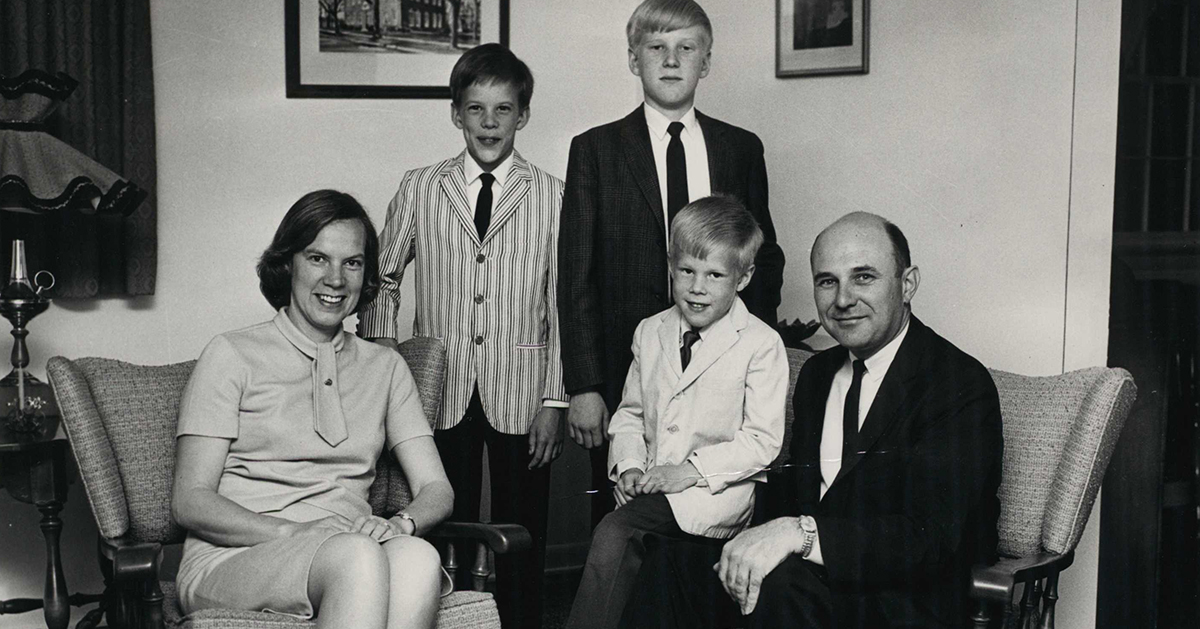
Twenty years later, in an interview taped at Moravian’s Media Center, Collier was asked what he would want to bring from his time as president to the college of 1995. Collier replied that what he most valued during his years at Moravian was something he hoped had continued over the decades, something he hoped would always endure: the sense of family, the feeling that the people at Moravian are more than colleagues or coworkers, more than groupings of faculty and staff, students, trustees, and alumni. “We have always been a family here at Moravian,” he said, “with respect for each other and a true family feeling. I hope we will always be just that—a real family.”
Collier first came to Bethlehem in 1950 to pursue his doctoral studies at Lehigh University. In those graduate school years, he and his wife, Jerri, lived in an apartment in a large home on Church Street owned by Pearl and Stanley Frantz, longtime members of the Moravian community, who became lifelong friends of the Colliers.
Decades later, Collier remembered walking across the Penny Bridge (precursor of the Fahy Bridge) to attend classes at Lehigh, and he had especially warm memories of their first Christmas in Bethlehem, when the Frantzes handed the Colliers the keys to their car and told the young couple to drive home to Virginia for Christmas so that they could be with their own families.
Working for the DuPont Company as a research chemist after graduating from Lehigh interrupted Collier’s academic career, but not for long. The Colliers returned to Moravian in 1955, when Herman was hired to teach chemistry. In those years, the modestly sized red brick Memorial Science Hall (now Memorial Hall), on Locust Street, housed most of the sciences. Science faculty also toted supplies and equipment to the Church Street Campus to teach classes there.
“We have always been a family here at Moravian,” he said, “with respect for each other and a true family feeling.
I hope we will always be just that—a real family.”
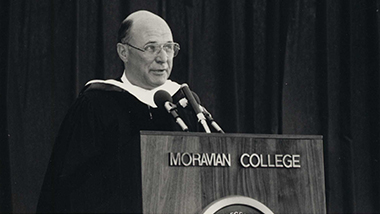
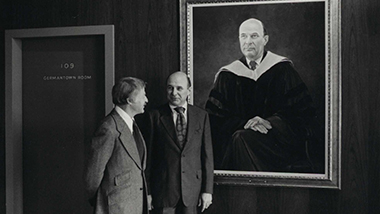
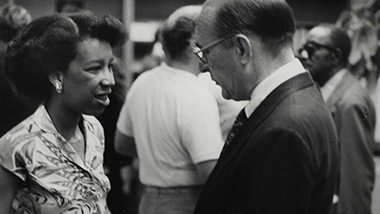
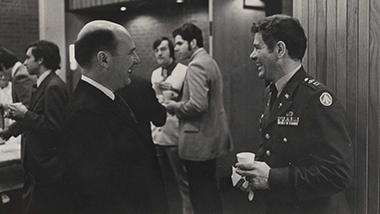
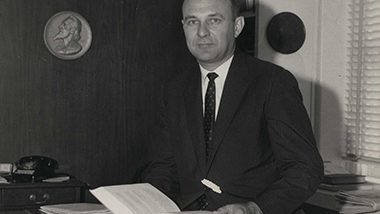
In the mid-1960s, Collier was asked to lead the planning for a proposed new science center. When he was named president of the college, in 1969, he was told, “now you have to pay for it.” After he retired from Moravian in 1986, the building was named the Collier Hall of Science.
During Collier’s presidency, Moravian grew in its enrollment, its physical plant and facilities, its course offerings and academic programs, its staffing, and its fundraising and endowment.
Collier also has a significant record of community service, which includes the Science Advisory Board of the US Environmental Protection Agency and, locally, the boards of St. Luke’s Hospital, the R. K. Laros Foundation, Horizon Health System, United Way, AAA of the Lehigh Valley, Bethlehem Chamber of Commerce, Moravian Academy, Northampton County Development Corporation, and the Lehigh Valley Association of Independent Colleges.
Herman Collier died on March 28, 2022, in Hershey, Pennsylvania. He was 94 years old. He is survived by his sons Edward and Thomas and their spouses, as well as nine grandchildren and two great-grandchildren. He was predeceased by his wife, Jerri, and by their son Michael and infant daughter, Kathryn.
Upon Collier’s passing, Moravian University President Bryon L. Grigsby said, “Herman is a significant figure in the story of Moravian University. He led the institution through a tumultuous period in American history, and his leadership created the foundation for the growth we’re experiencing today. I know many alumni will remember him fondly, and the entire community will keep the Collier family in their thoughts.”
In the many comments and remembrances received by Moravian since Collier’s passing, several themes surface again and again: “a gentleman, the quintessential Southern gentleman” . . . “a true academic, devoted to teaching and learning” . . . “the ability to be a leader and a listener” . . . “rock-solid respect for the faculty, individually and collectively” . . . “the ability to express thoughts and feelings, from delight to despair, without using vulgarities or denigrating others” . . . “He naturally melded the case for a project with a genuine Southern charm and obvious passion for Moravian, carefully adapting it to a large gathering of alumni, a corporate executive, or the widow of a Moravian pastor” . . . “charming, with a wry sense of humor, he could nevertheless be steely when required” . . . “he had a joy in living, whether on sailing trips with dear friends or spending time with his children and grandchildren” . . . “his life is more to be admired than his death is to be mourned.”
The Moravian family will miss him.
To read remembrances of Herman Collier from the Moravian University community, visit mrvn.co/collier.
Highlights of Herman Collier’s Presidency
1969 Ground broken for the Hall of Science (March 14)
1971 Completion of Hall of Science
1972 Construction of Jo Smith Hall
1973 Renovation of Memorial Hall to include a Media Center and space for Student Services as well as renovated classrooms
1976 Completion of the Bahnson Center; renovation of Brethren’s House and West Hall
1981 Expansion of the Haupert Union Building and creation of its Arena Theatre
1982 Opening and dedication of the Payne Art Gallery and Foy Concert Hall
1983 Exterior and interior restoration and renovation to Comenius Hall; completion of Harvey T. D. Gillespie Baseball Field
1984 Completion and dedication of Timothy M. Breidegam Track at Steel Field Athletic Complex
1985 Inauguration of the MBA program