
When newly elected US Senator Gaylord Nelson (D-WI) arrived in the capital in 1963, he realized that the federal government had no coherent environmental plan. He encouraged the Nixon administration to create new conservation-focused positions and urged Congress to enact environmental legislation. And in the fall of 1969, he proposed mobilizing public opinion with a series of national environmental “teach-ins” at more than 1,000 college campuses the following April.
On the Moravian College campus, activities and exhibits on that first Earth Week, April 16 to 22, 1970, focused on pollution—a problem the nation was only just beginning to tackle. A February 1970 article in the Comenian highlighted the health risks of the smog that then shrouded America’s cities (Bethlehem more than most). Comenian reporter Debbie Faust made a dire prediction: “Theoretically,” she wrote, “the blanket of smog around the earth may eventually change the weather drastically, causing either extreme heat or cold.” Another 1970 Comenian article educated Moravian students about water pollution caused by phosphate-containing laundry detergents. “These phosphates are the chief cause of our present water pollution problem,” speeding the growth of algae, the reporter noted. “Only national awareness and immediate action by every concerned citizen can stem the tide of pollution until such time as detergent formulas are changed and improved sewage systems constructed.”
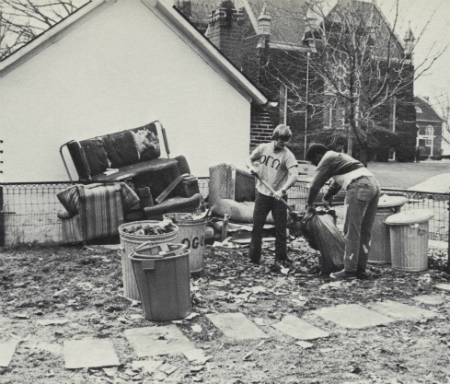
Earth Day 1970
One of the highlights of Earth Week at Moravian was an exhibit in Johnston Hall of more than 40 different ecology-related displays. Among the concerns addressed: population control; air, water, and noise pollution; land-use planning; pesticides and herbicides; and solid wastes. A major focus was the reduction of nonbiodegradable consumer products; among the more popular exhibits was a display of soda and beer cans collected from the college’s dorms in one week. Environment-focused films played continuously, and students and guests signed petitions requesting government action on the environment.
On April 20, 1970, Bethlehem gynecologist Frank Schramm, Ph.D., presented a lecture in the Haupert Union Building on “The Sexual Explosion and Family Planning”—a major topic of Earth Week events nationwide. (Lafayette and Cedar Crest Colleges hosted Paul Ehrlich, author of the controversial 1968 book The Population Bomb.)
Commenting on the thought-provoking events of that week, the Comenian posed a question: “We can’t take as long to correct our mistakes as it took us to create them,” it warned. “Can we afford to wait?”