In Search of Planets
Ever wonder what lies beyond our solar system? Bryan Kelly does. He earned a bachelor of science in physics with minors in mathematics and computer science, and this fall he will attend Florida State University, where he will pursue a PhD in physics specializing in astrophysics. His undergraduate research with Ruth Malenda, assistant professor of physics, led to his honors thesis, “Photometric Analysis of Variable Star Systems,” through which he observed eclipsing binary systems and exoplanets.
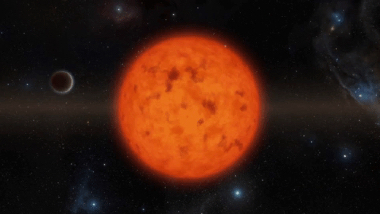
View a NASA GIF of a transit at mrvn.co/nasagif.
What is an exoplanet?
An exoplanet is any planet that orbits a star outside of our own solar system; they are also commonly referred to as extrasolar planets. There are over a hundred billion galaxies in the known universe, each containing hundreds of millions of stars, each of which could have planets in their systems.
Source: Cowley, Michael and Hughes, Stephen.
Characterization of transiting exoplanets by way
of differential photometry.
Physics Education. 49, 293 (2014).
How do we know they are there?
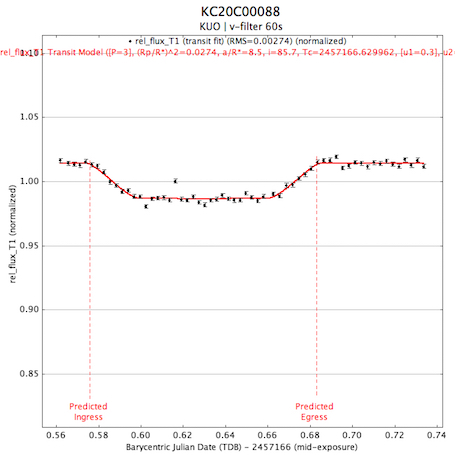
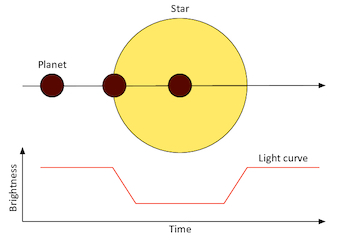
Discovering an extrasolar planet is not as simple as looking through a telescope at the night sky. Planets are not sources of light; thus we need to look at the stars the planets orbit in order to “see” them. To detect a planet, we can study the variation in the light emitted by the host star as the planet passes in front of it, which causes a decline in the light seen from Earth, similar to the eclipse we see when the moon travels in front of the sun. Once the planet moves past the star, the star’s observed light will return to its normal intensity. The process of an exoplanet passing in front of its star is known as a transit, and the light emitted from the star as time passes can be plotted to create a light curve.
How could you help find an exoplanet?
There are two main missions right now that are constantly searching for stars that may have exoplanets present in their system: Kilodegree Extremely Little Telescope (KELT) and Transiting Exoplanet Survey Satellite (TESS). Both missions use telescopes that take very wide, low-resolution photos that capture thousands of stars. These images are then sorted using computer algorithms, and a list is compiled of potential star systems that may contain exoplanets. Both professional and amateur astronomers follow up with this list, take their own observations, and create light curves that will confirm or deny the presence of an exoplanet.
Why do we study planets outside our solar system?
The obvious reason extrasolar planets are studied is to see if we can search for signs of life outside of our solar system. Using a technique known as spectroscopy, astronomers can determine if planets might have liquid water at their surface and the right mixture of gases (oxygen, carbon, nitrogen) in their atmosphere needed to harbor life on that planet. Exoplanets are also researched to discover the wide variety of planets that exist in the universe and the conditions that lead them to be created, which gives us clues about the origins of our own solar system.