

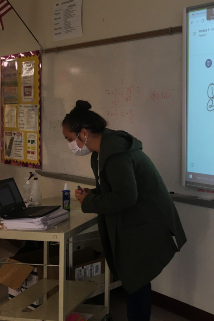
Gabrielle Smith MEd ’20 teaches mathematics simultaneously online and in the classroom at Whitehall High School.
Communication in Mathematics
How the pandemic put an MEd graduate’s thesis to the test
By Meghan Decker Szvetecz ’08
When math educator Gabrielle Smith MEd ’20 was completing her graduate thesis this spring, she couldn’t have imagined how timely her research would be to the pandemic coming right around the corner. Smith’s thesis, titled “Communication in Mathematics: Its Impact on the Students in the Classroom and Beyond,” helped her College Prep Algebra I students at Whitehall High School, north of Allentown, Pennsylvania, develop their communication skills in her classroom and in everyday life. As students’ confidence improved, so too did their scores on assessments, and Smith’s approach laid the groundwork for navigating a school year in which communication is paramount—for the students and for her.
Diving into Technology
In response to the pandemic, the high school completed the rollout of its 1:1 technology plan, so students in every grade received a Chromebook. And since hands-on tools such as compasses and protractors could no longer be shared, they were replaced with digital tools such as Google Draw and Kami.
On any given day, Smith juggles three out of six different math classes, three computers (“I’m on Zoom with one, another is my video, and I’m showing my screen on the other”), and three groups of students learning simultaneously. Like many area school districts, Whitehall is following a hybrid schedule in which students attend class in person two days a week and learn remotely from home the other days.
This means that a quarter of Smith’s students are physically in class, three-quarters are online, and still another group of cyberschool students all tune in to Smith’s lessons. “I’m not sure I have completely figured it out just yet,” Smith admits. “For me, it’s a matter of really focusing in on the idea that both sets of students deserve a quality education.”
Smith’s graduate research pushed her into determining how best to use new technology platforms. “It really made me dive into things like Flipgrid, Edpuzzle, incorporating Google Classroom, and giving the kids surveys,” she says.
Communication Application
Smith says she began the school year strictly using Edpuzzle (an online platform that allows users to create and share interactive video lessons) for live instruction, but she could tell early on that she wasn’t building a rapport with her students. So she adjusted to using the platform to upload prerecorded videos of herself talking through math problems with the incorporation of more live teaching.
During her graduate research, Smith asked her students to make this process reciprocal, so they too created and shared videos demonstrating the steps they use to solve an equation using the application Flipgrid, she explains. “I would assign them a problem, they would work through and explain their thinking, and then we would do more problem-sharing.
“To extend communication to a different realm, I would frequently ask them questions like, ‘How are your communication skills evolving?’ ‘When can you communicate?’ and a lot of students would say, ‘I need to communicate when I’m in the workforce,’ or ‘When I’m working with someone else.’”
Students started to pick up on the idea that these communication skills extend beyond math, Smith says, and it opened their dialogue to discussions of COVID-19 and the increasing social unrest in the country. “They want to feel empowered, they want to speak their minds, and they want to do it in a way that’s really beneficial to all parties involved,” Smith says of her students.
“They want to feel empowered, they want to speak their minds, and they want to do it in a way
that’s really beneficial to all parties involved.” —Gabrielle Smith MEd ’20
Challenges and Expectations
Smith’s students may be the generation most comfortable with technology, but that doesn’t mean that remote learning doesn’t come with its challenges, she explains. “Right now, the hardest part for students is knowing, ‘Do I type my question here?’ ‘Do I just yell it out in the mic?’ With any Zoom meeting there’s that awkwardness of, ‘When do I go?’”
The other challenge, Smith says, is training a generation of students adept at informal tech communication to use the Zoom chat feature in a professional manner. “I had an instance where students were asking questions to each other about their plans after school, which normally might be chatter that they have in the classroom. That doesn’t really impact much as they’re coming in for the day, but when it’s online now I have to look through that to find math questions.”
In five of her six classes, Smith says, she is lucky to have the support of various coteachers who act as another set of hands during the daily pull in two different directions, “so if I need to help a student in the class, then I have a coteacher to monitor online. If I’m focusing online, I have a coteacher who can help someone in class.”
The other concern for Smith is making sure her students at home are actually in front of their screen for the entire class, which is why she relies on Edpuzzle to help her out, she explains. “I can watch their progress and I can make sure that they are viewing the content. It gives the student a little more accountability, and it allows me to know that this student is getting the content. I’ll just wait to see if they have a question.”
Students are expected to be in front of their screens throughout the school day, and for that reason Smith says she decided not to assign homework and to get all of their work completed within the class period. Smith acknowledges that she was lucky to grow up in a very supportive, stable home that would have been conducive to online learning, but that may not be the case for many of her students. Not having homework also allows students to finally shut off their devices and relax at the end of a long remote learning day.
Smith hopes that this adoption of virtual learning and the communication skills that develop along with it will be an advantage to her students after they graduate. Face-to-face interaction may be limited by the pandemic, but perhaps their frequent Zoom interactions will offset that. Students will be adept at interacting in small virtual cohorts, she points out, and perhaps this will open doors to students of lower income to be able to attend more prestigious schools online without the barrier of paying for room and board.