

David Quammen: Forewarner of the Next Viral Pandemic
Author and public health writer discusses the looming threat of the next viral disease
By Jonathan Fiore ‘18
David Quammen, a writer for National Geographic and author of Spillover: Animal Infection and the Next Human Pandemic, spoke of dangerous viruses like Ebola and Zica and their impact on our understanding of disease on Thursday. In his address, which took place in Moravian University’s Johnston Hall, Quammen expressed we as a nation—and more so, the world—lack a large understanding of what causes viral diseases to spread, and how they came into human contact.
Quammen’s own understanding of infectious diseases began with a single spark: an article he read about Ebola in the late 1990’s. “I always had an interest in the mystery of the reservoir host, which stemmed from my work with National Geographic,” he said. He quickly learned how ecology and biology are important parts of understanding viral diseases, and the mysteries of Ebola and its ecology inspired him to search for answers. Quammen’s goal: to be a little more prepared for a new animal-borne virus.
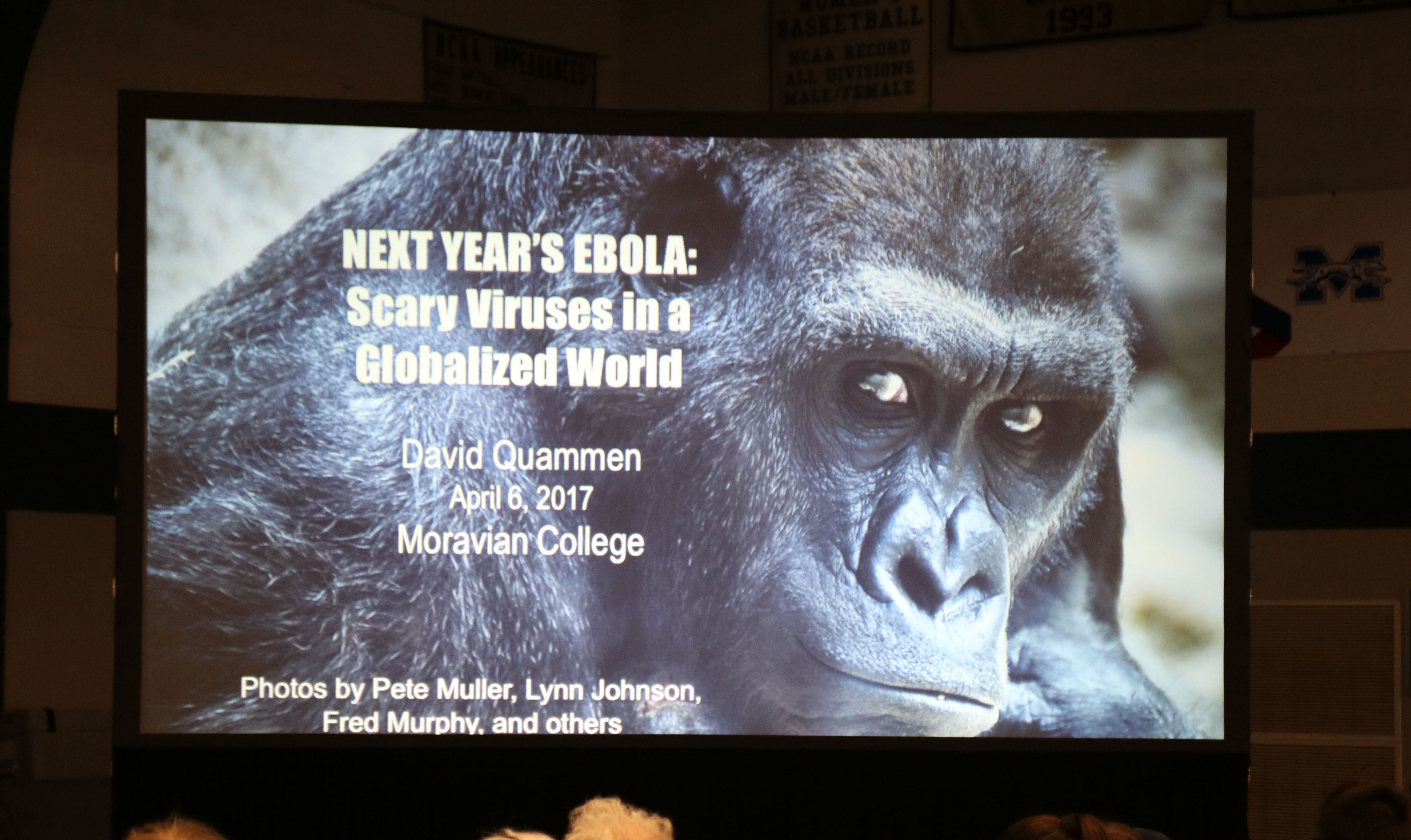
Quammen decided to share what he learned with the populace, in the form of books, articles, and talks similar to this one. His book, Spillover, discusses the effects and consequences of an animal-borne virus that spillovers into the human population and thus causing a pandemic. He recounts his interviews with a variety of scientists within the field tracking this subject and discover what it means for the sake of humanity in a page-turning drama.
He explained to the audience how a zoonosis, or an animal infection that is transferable to humans, can easily be compared and shared to a human disease since both come from nature. “Of the 1407 known species of human pathogens, 58 percent of them are zoonotic,” he said.
A reservoir host, which was one of the main focuses to his book, is any species that a zoonotic virus can thrive in without any threat, usually a wild animal. These animals can spread zoonotic viruses to humans through blood to blood contact, in the case of HIV, coming into contact with animal droppings, in the case of Ebola in West Africa, eating the bush meat of the infected animals, or even an animal sneezing on you—which was the case with MERS, or Middle East Respiratory Syndrome.
Once a zoonotic host passes its virus to a human host, it can cause a spillover—the same term that inspired his book. The virus only needs to take a single plane or boat ride before it spreads through the world.
Even with this knowledge of “how,” Quammen, is working to shed light on why these potential pandemics spread, and at such speeds.“Why is this happening?” Quammen says, “The disruption of animals ecosystems.” Reservoir hosts are getting closer and closer to human civilizations, bring the viruses with them.

How can you stay safe? The first way, he says, is to understand the dynamics of the virus. And of course, “If you feel sick stay at home and rest up, don’t go to school,” Quammen says.“It is a part of your own responsibility to make sure you don’t get others sick.”
The second way is individual responsibility of prevention—vaccinations are important to help prevent the spread of these diseases, and Quammen urges others to stay up to date with the CDC “We have our own responsibility to keep ourselves safe from these viruses,” he says.
The third tactic is through collective responsibility. “We have the tools to handle Ebola, [underprivileged countries] don’t,” he says.“As responsible citizens of the world, it is our job to help those who don’t have the care that we have.”
Even though many of these diseases like Ebola don’t have any cures or treatments, Quammen says that we can still fight back and prepare for the new ones that are sure to come.