
Suzanne Creelman - Class of 2003
Art Major
Corporal PA State Police
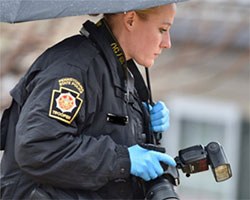
How did an Art Major decide to become a State Trooper?
Crazy story how I got to where I am. I transferred to Moravian to be closer to home and play basketball. I had no idea what I wanted to do with my life. It came to my senior year and I needed to declare a major. I only needed two more classes to be an Art major and graduate on time. After graduation, I started traveling the country working as a photographer. I loved photography but did not like all of the traveling. One weekend, during a massive snowstorm, the driver I was with crashed and went down a 100 foot embankment. I did not know a single thing on how to help, how to get us out of this situation so basically, I just had to wait for the police and fire department to get there to help us. I literally signed up the next day to learn how to get my EMT. I worked as a full time EMT for a number of years and I realized that I like helping people but being an EMT does not pay much. While I was an EMT, I was also a volunteer EMS in New Jersey and I ran into a lot of NJ State Police. They encouraged me to think about becoming a Trooper. I did a little research and at the time NJ state police was on a hiring freeze. I still had a lot of friends from college in the Lehigh Valley so I looked into PA State Police. I wound up getting through the PA State Police Academy and 16 years later, here I am.
What is your favorite podcast at the moment?
I’m a big football and Philadelphia Eagles fan. So I follow the New Heights podcast with Jason and Travis Kelce. I’m also really into Kylie Kelce podcast Not Gonna Lie. I listen to that one a lot. They are both fun podcasts to listen to.
What is something you wish you could tell your 20 year old self?
Study more. I think I was so wrapped up in sports, I wish I would have thought about the future more than just being in the moment. I don’t think I would want a different career just more options. I wish I would have studied more, taken Spanish as a second language. Really concentrate on the studies and what you’re investing in your future.
How did Moravian prepare you for your current role?
Time management. Being an Art Major and having to be down at South Campus all the time and then having to get to basketball practice I really learned time management at Moravian. It was very helpful and taught me a lot because when you’re in the academy, time management is everything. It is a very intense atmosphere.
What are your current future plans?
I did take the promotion exam last year. Right now I’m a Corporal. I’m hoping be promoted to Sergeant sometime late next year.
What is your favorite part about working for PA State Police?
When I was in the academy, they did a presentation on the forensic services unit and I knew I belonged in that unit. I can use my photography degree and my love of a camera. I did 10 years in crime scene investigation taking a lot of pictures. One thing I will tell anyone that is looking into law enforcement is the amount of opportunities provided to you by PSP is astronomical. There are over 150 specialized positions with a lot of different avenues you can take to further your career getting to do what you like to do.
Nina DePalma-Fliss - Class of 2017
Sociology Major with Political Science and Women’s Studies Minor
Staff Attorney for Volunteers Lawyers for Justice
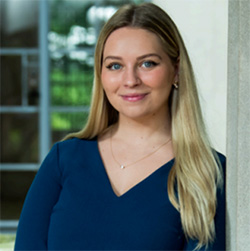
How did Moravian prepare you for your current role?
Because Moravian is a small school, you get a strong sense of community. Heritage Day is a great example, to give back to the community that you live in and benefit from. I also took a seminar on the refugee crisis that inspired me to go to Greece volunteering with Syrian Refugees after graduation. I also completed an honors project that focused on mass incarceration and the prison industrial complex. All of these experiences had something in common; pay attention to humanity around you and do what you can to help. Moravian taught me to take care of those around you, and they’ll take care of you too. That sense of community I got from Moravian has led me to the work I do now, preserving housing for New Jersey’s most vulnerable people.
How did Moravian help shape your career path?
When I started, I was enrolled in a disability rights writing Seminar. We discussed disability rights in America. I learned so much on a subject I wasn’t previously familiar with. It challenged me to reinspect facets of my life with a new perspective. Now more than ever it’s important to have opportunities to challenge your world view, confront topics that may be uncomfortable to talk about, and learn from that. I carried that sentiment through college, continuing to challenge myself and become an advocate.
What is your favorite book at the moment?
My best friend from Moravian is an author, Alexandria Paige. I’m currently reading her newest book A Witch in Notting Hill.
What was the most important lesson you learned at Moravian?
How important it is to give back. Especially now, there’s a real empathy problem in America. I think that social media gives us the illusion of community without really being connected. People feel more alone than they let on and it’s getting harder to connect to people on an authentic human level. I wish we’d all take care of each other more. You never know what someone is dealing with- so approach every interaction with care. We’re all doing our best!
What good advice did you receive from a professor?
I went into Dr. Adams O’Connell’s classroom feeling frustrated and down on myself. She told me she saw so much potential in me and made me feel capable and inspired. It was the first time I really felt seen academically by a brilliant professor I admired and respected so much. She reminded me how much I was capable of; and gave me the confidence to approach my career with a “can-do” attitude. I do belong in these rooms, in these conversations, I am going to be a lawyer and a damn good one at that!
What are your current future plans?
I plan to stay with my current organization, VLJ which is a nonprofit providing pro bono civil legal services to economically disadvantaged people in NJ. I do boots on the ground work, treating symptoms of much larger societal issues. My goal is to eventually be more involved in the policy side of things that really treat the problems. Real stability relies heavily on housing; your ability to hold a job or access to quality healthcare and education when you don’t have a stable place to live. I hope to improve housing outcomes for everyone in need.
Matthew Bartholomew - Dec. 2003
Sociology Major
Professor, Counseling (Tenured), Northampton Community College

How did Moravian help shape your career path?
When I graduated Moravian I got a job at Kids Peace right away as a Child Care Councilor and it was pretty clear how well Moravian prepared me for a broad scope of different positions. I wasn’t sure exactly what I wanted to get into but I knew I wanted to help people.
What is something you wish you could tell your past self?
Continue to keep your sense of humor. Looking back; conscientious, hard-working students put a lot of pressure on themselves. You need to have a nice balance between life and your academics. Have some fun, get to know people, enjoy yourself and keep a sense of humor. You need to find time to laugh. You only know what you know at the time.
Do you have any advanced degrees?
Moravian prepared me perfectly for grad school. I remember the hands-on research projects to this day.I went to Kutztown for my Masters in Higher Education in Student Affairs, College Counseling Licensure. What was neat about this program is it mixed in higher ed, I was already at NCC at the time, and counseling requirements for a Licensed Professional Counselor. I became a LPC 5 years after getting my Masters.
What is your fondest memory of your time at Moravian?
One stand out memory it is the induction to AKD ceremony. My fiancée and parents were there. To be in that moment with your classmates and get that recognition that was a standout moment.
How did Moravian prepare you for your current role?
The faculty are just amazing, Dr Wetcher-Henricks especially. The small classroom size is a big part of why I chose Moravian. It is a cohort style model where you get to know other students in your program as well as your professors really well. With regards to the program itself, critical thinking and problem solving are the two things that have served me well in my career. Being able to understand diverse populations, group dynamics and multi-cultural work places. NCC is a very diverse college. Those skills and understanding put me in a great position to be employable.
What is your favorite book or podcast at the moment?
I’m not a big book reader, but being involved with the American Counseling Association I have access to all their professional articles and that is what I read. I’m really into nutritional counseling and have done a certification program for that. It’s amazing how unaware students are about what they are putting into their bodies and how it impacts their mental health. Food affects mood. I like podcasts related to whatever sports season it is. Right now it’s baseball season so I am like listening to the Phillies Podcast called “High Hopes”. I chase anything that makes me laugh and gives me a chance to get away. I strive to find good balances through sports and humor. The depth of the work that I do, I need a reprieve. That is a good piece of advice for students, self-care. Self-care is so important whatever that means for you; reading, art, whatever it is, just make sure you take the time to do it. I also like reality TV. I think as a sociology major there is something fundamentally interesting and funny about it.
Dr. Kelsey Ann Graham - Dec. 2013
Sociology Major with Public Relations Minor
Education Consultant

How did Moravian help shape your career path?
I find it odd that people consider a sociology degree useless. How can the study of society be useless? By majoring in sociology, political science or psychology, you are a change maker. You understand how people move as a group, have a wide view of society and how it impacts people. You can apply that to so many different fields. I've worked in law, marketing, sales, non-profits, startups and I've traveled. My sociological mind, degree and everything I’ve learned, at the end of the day is about how to be respectful of others. That journey started at Moravian and set the tone for my academic foundation.
What is your fondest memory of your time at Moravian?
I was very involved as a student and in debate. We went to the national competition the year I was president. I got to practice my own type of leadership and really hone those skills. When you're leading your peers, you have to be very diplomatic, empathetic, understanding, and listen as to why someone is not doing something. You have to make those hard decisions, but there also decisions you're making with friends.
What is your favorite podcast at the moment?
I'm starting a podcast about the education system, it’s limitations and how to navigate it. What I've realized in my work is; what happens when you don't have a good foundation of study habits or time management? What happens is you get overwhelmed and anxious, and once anxiety rises up in your head, you cannot think straight. You cannot learn if you are in fear, anger, or anxiety.
What good advice did you receive from a professor?
Dr. Jasper was the quintessential scary professor however I grew so much in his class as a writer. I learned that no matter how scary someone is, I can only improve if I go to office hours and listen to the advice that's being given. One of the best pieces of advice he gave me was, for every class, at the end of the semester, write down what you got from the class and how it will go into your future career to build a master resume. Because you're not gonna remember 3 years from now what you did. You need to write it down when it's fresh.
What is something valuable that you’ve learned as an Education Consultant?
A lot of my clients have been told in K-12, that they are not capable. They may have an undiagnosed learning disability or undiagnosed neurodivergent. I got diagnosed with ADHD at 30. I was always an A student and I got overlooked because I didn't typically present with ADHD, until I burned out. And so, how do you model your life, so you can function and not burn out? I encourage people to really think about their career as a whole, not just one job, or one company. You may think that you need to be at a big company but the way those companies are structured, may not actually work for you or the way your brain works. Especially if you're neurodivergent. Working Monday-Friday, 9 to 5, might not be a good fit for you. So how do you navigate the higher education system in a way that helps you collect the skills and the mindset for your career. Not just a job, a career. I think it is helpful to take a step back, and really truly think through what your degree looks like.
Eyliena Baker - Class of 2020
Sociology Major with Women’s Gender and Sexuality Studies Minor
Business Analyst for Peak Performance Solutions

How did Moravian prepare you for your current role?
Growing up, I was overshadowed and talked over. I still am at Christmas. When I got to Moravian, I fell into such a comfortable place. I still look back fondly because I found my voice, I found being comfortable, I found people who would listen wholeheartedly. I had so much love for authentic conversations and connections, which is 100% the theme of being at Moravian. I was such a timid thing growing up, and then I got to Moravian, and realized I can be a leader. I gained so much confidence. My boss recently left to peruse something else and I was able to step up and become the interim development manager.
How did Moravian help shape your career path?
I started at Moravian intent on law school. I was president of the Pre-Law Club and interned at Northampton County Courthouse. Then covid hit. Yes, law school sounded great, but when I had a minute to reflect, I was like, I don't know if I want to do this. My degree is in sociology, which could be applied to many things, and it does. I am in software right now, and I absolutely love it! My entire curriculum, my entire way of life when I was there was law school and now I'm not doing any of that. I don't think I would have been comfortable accepting my promotion to manager without the authentic connections and experience that I had at Moravian. I will always be grateful for that.
What is your favorite book at the moment?
I've been reading a lot of fantasy. That's been my escape from the world right now. I finished A Court of Thorns and Roses series and I loved Fourth Wing.
What is something you wish you could tell your 20 year old self?
I would say, you have a really good head on your shoulders and you just have to trust that you do. Your experience and your connections with people is only going to get better. You don't have to have a million things on your resume, you don't have to have all these things. If you have a good mindset and a good head everything will be just fine.
What are your current future plans?
I'm looking forward to a new chapter. My boyfriend and I have been in Tallahassee for 5 years and we have both really focused on our professions and integrating into the workforce. He's been working on getting his PhD, and I wanted to really throw myself into becoming a successful person in the work field. So now we're both excited for me be comfortable with my new leadership role, in this very new field to me, because software was never on my radar. We're excited for the next chapter of life, where we're situated and can kind of like enjoy life to its fullest without working our butts off. Preferably abroad.
What is your fondest memory of your time at Moravian?
I was asked to give a speech on what scholarships and donations have done for me at the Comenius Dinner at Hotel B. Which was crazy for me to get up and do. I come from Kunkltown, PA, my mom was a single mom with 6 kids, and it helped immensely for me to be able to come to a school like Moravian. In my speech I reflected on my time here. It was such a wonderful stage, literally and figuratively, to be on. I felt so empowered. I actually still have framed pictures from that night.