
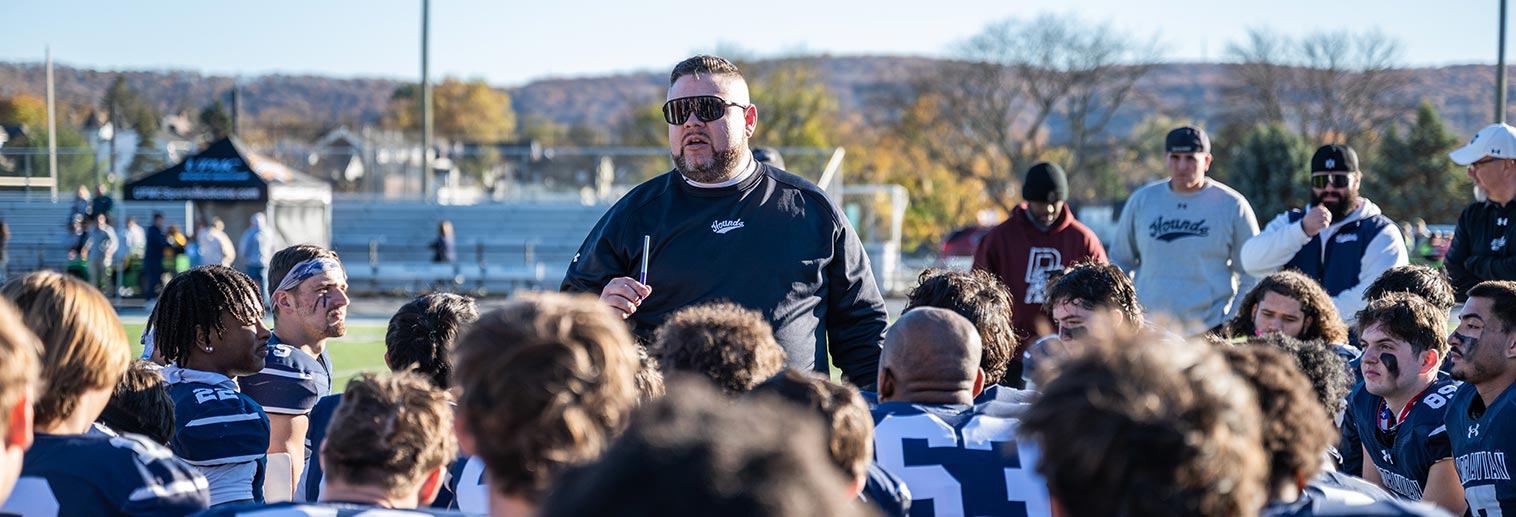
Moravian University’s Sport & Performance Psychology Clinic
Enhancing performance, supporting well-being, and expanding access
The Moravian University Sport & Performance Psychology Clinic provides supervised mental performance consultation, education, and skill-building services to students, student-athletes, performing arts students, coaches, and teams. Its goal is to enhance individuals’ performance, well-being, growth, and confidence through evidence-based psychological skills training—helping with performance anxiety, stress management, and more, through mindfulness techniques, team cohesion workshops, and additional support.
Under the direction of Clinic Director Logan Stano, MS, ABSP, LPC, the clinic will be staffed with several interns from Moravian’s Sport & Performance Psychology program. It operates under a pro-bono model to promote equitable access and maintain an educational focus.
Make a Referral
Students, student-athletes, coaches, athletic trainers, faculty, staff, or other university community members may submit a referral through the clinic’s online referral form. This is required for individuals to be seen by appointment only.
To submit a referral email sportpsychclinic@moravian.edu
The referral form is used to help clinic staff understand the general nature of the request and determine whether sport psychology services are an appropriate fit. If so, a clinic representative may reach out to the referred person to schedule an initial consultation. Submitting a referral does not guarantee services or establish an ongoing consultation relationship. The form is not monitored 24/7.
Please note that informed consent must be obtained prior to services (Consent Form link) and the clinic operates under FERPA guidelines for student records.
Sport Psychology Clinic Services Included
The clinic offers individual consultation, team-based services, and group programming when available. *All services are consultative and educational in nature and may include:
- Goal setting and performance planning
- Injury adjustment
- Focus and attentional control training
- Arousal regulation strategies
- Pre-performance routines
- Imagery and visualization
- Self-talk and confidence enhancement
- Stress management for competition
- Team workshops
- Psychoeducation (as it pertains to sport and performance)
- Referral triage
*Interns in the sport & performance psychology clinic may not provide diagnoses of mental health disorders, mental health assessments, counseling, treatment of anxiety, depression, substance use, trauma, eating disorders, or other clinical conditions as outlined in the DSM5-TR. The clinic is a separate but complementary service to the university’s Counseling & Psychological Services (CAPS), where all clinical concerns will be directed.
FAQ
The Moravian University Sport Psychology Clinic operates with structured supervision, strong institutional safeguards, and ethical integrity. Its mission is to enhance performance while protecting student welfare and maintaining alignment with university policy and professional standards.
What is the Sport Psychology Clinic?
The Sport & Performance Psychology Clinic provides mental performance consultation, education, and skill-building services for students, student-athletes, teams, coaches, and performance groups. The clinic helps individuals and teams build psychological skills that support performance, confidence, focus, motivation, communication, team cohesion, and overall development in sport and performance settings.
Can I refer myself?
Yes. Students and student-athletes may submit a referral for themselves using the online referral form. Self-referrals are encouraged. You do not need a coach, athletic trainer, or faculty member to refer you.
What happens after I submit a referral?
After a referral is submitted, the clinic staff will review the information to determine whether the clinic is an appropriate fit. Possible next steps include contacting the referred person to schedule an initial consultation, requesting more information, recommending another campus or community resource, or referring the concern to a more appropriate service such as Counseling & Psychological Services, athletic training, student health, or another provider. Submitting a referral does not guarantee services or create an ongoing consultation relationship.
How long does it take to hear back?
Referral forms are reviewed during regular university business hours and we aim to respond within 48 hours. Response time may vary depending on clinic staffing, the academic calendar, semester schedule, and referral volume. This form is not monitored 24/7 and should not be used for emergencies or urgent safety concerns.
What is the first appointment like?
The first appointment is usually an initial consultation. It is a chance to discuss your goals, current challenges, performance context, and whether sport psychology services are a good fit. You may talk about what you hope to improve, what has been difficult, what strategies you have already tried, and what type of support might be useful. The first meeting is also an opportunity to ask questions about the clinic, privacy, supervision, and next steps.
What kinds of concerns are appropriate for the clinic?
Common reasons someone may use the clinic include confidence, focus and concentration, performance anxiety or nerves, managing pressure, motivation, goal setting, pre-performance routines, self-talk, imagery, injury adjustment, return-to-play confidence, communication with coaches or teammates, leadership, team cohesion, and burnout or stress related to performance. The clinic is most appropriate when the primary concern is connected to performance, sport participation, team functioning, or mental skills development.
Can the clinic help with performance anxiety?
Yes. Performance anxiety, nerves, and pressure are common reasons people seek sport psychology consultation. Consultation may focus on skills such as breathing, attentional control, self-talk, preparation routines, imagery, confidence-building, and strategies for responding to pressure. If anxiety is severe, persistent across many areas of life, or causing significant distress or impairment, Counseling & Psychological Services or another mental health provider may be recommended.
Can the clinic help with injury recovery?
Yes, when the concern is related to the psychological or performance aspects of injury recovery. Examples may include confidence returning to play, fear of re-injury, motivation during rehabilitation, frustration during recovery, identity adjustment during injury, maintaining focus and routine while injured, and communicating with coaches, teammates, or athletic trainers. The clinic does not provide medical care, physical rehabilitation, or return-to-play clearance. Those concerns should be addressed by athletic training, student health, or a medical provider.
Can teams request workshops?
Yes. Coaches, athletic trainers, team leaders, or campus partners may request team-based programming. Common workshop topics include confidence under pressure, focus and reset routines, team cohesion, communication, leadership, motivation, mental preparation, injury recovery and return-to-play confidence, and managing performance stress. Team workshops are scheduled based on clinic availability, supervisor approval, and fit with the clinic’s scope.
Do I need to be an athlete to use the clinic?
Sport and performance psychology focuses on elevating human performance and well-being across many domains, including sport, exercise, tactical and public safety occupations, performing arts, business, leadership, and other performance settings. The Moravian University Sport & Performance Psychology Clinic primarily supports individuals and groups with sport, performance, and well-being related goals or concerns. If you fit into any of these broader performance categories, you are welcome to request services. Common areas of support include confidence, focus, motivation, performance anxiety, preparation routines, leadership, communication, team cohesion, injury adjustment, stress management, and managing pressure. All requests are reviewed to determine fit with clinic scope, staffing, and availability.
How many sessions will I attend?
The number of sessions depends on the person’s goals, availability, clinic capacity, and whether the clinic is an appropriate fit. Some students or athletes may attend a brief series of sessions focused on a specific skill or goal. Others may participate in team workshops, group programming, or short-term individual consultation. It is important to note that this clinic is only open during the fall and spring semesters in accordance with the Moravian Academic calendar.
Is this confidential?
The clinic respects the privacy of those who use services. Information is handled according to applicable university policies, privacy laws, and clinic procedures. Because this is a supervised training clinic, information may be shared with clinic supervisors for training, oversight, safety, and quality assurance purposes. However, any information utilized in an educational setting will be de-identified and redacted as needed. Limits of privacy will be reviewed before services begin.
Will my coach know what I talk about?
In general, the clinic does not share detailed information from individual sessions with coaches, teammates, parents, or staff without appropriate permission. If communication with a coach would be helpful, the student or athlete and intern can discuss what information may be shared and how. For team services, communication with coaches is generally focused on broad programming goals, team-level themes, logistics, and general recommendations rather than private individual details. Limits of privacy will be reviewed before services begin.
Can the clinic communicate with my coach, athletic trainer, or counselor?
Sometimes, but communication with others should be discussed clearly and will require you to sign a release of information. In some cases, collaboration with athletic trainers, coaches, Counseling & Psychological Services, or other support providers may be helpful. The clinic will discuss what information may be shared, why it may be useful, and what permissions may be needed.
What are the limits of privacy?
Limits of privacy may include situations involving immediate safety concerns, risk of harm to self or others, abuse or neglect reporting obligations, legal requirements, university policy requirements, or other circumstances where disclosure is required or permitted. The clinic will review privacy expectations and limits before services begin.
Will using the clinic affect my playing time or standing on the team?
No. The clinic is designed to support student-athlete development and performance. Using the clinic should not be treated as a weakness or punishment. The clinic does not make playing time decisions, team selection decisions, return-to-play decisions, or disciplinary decisions.
Is sport psychology the same as counseling?
No. Sport psychology consultation and counseling can overlap in some broad areas, such as stress, confidence, motivation, and coping, but they are not the same service. The Sport Psychology Clinic focuses on mental performance skills, education, and consultation. It does not provide diagnosis, psychotherapy, crisis counseling, or formal mental health treatment. Students seeking counseling or mental health treatment should contact Counseling & Psychological Services or another appropriate healthcare provider.
What concerns are better suited for Counseling & Psychological Services?
A referral to Counseling & Psychological Services or another mental health provider may be more appropriate when the primary concern involves depression, significant anxiety outside of performance settings, trauma, eating or body image concerns, substance use, self-harm, suicidal thoughts, crisis-level distress, relationship or family concerns requiring therapy, ongoing mental health treatment needs, diagnosis, or medication-related concerns. The Sport Psychology Clinic may still collaborate with or refer to other campus resources when appropriate, but it does not replace counseling or mental health treatment.
Can the clinic diagnose mental health conditions?
No. The Sport Psychology Clinic does not provide diagnosis, psychotherapy, or formal mental health treatment. Students seeking any of those services should contact Counseling & Psychological Services, student health, or another appropriate healthcare provider.
Can my coach require me to attend?
A coach may recommend or refer an athlete to the clinic, but individual participation in services is voluntary. Team workshops or team-based programming may be part of a broader team activity, but individual consultation should be based on the student or athlete’s willingness to participate.
Who provides services?
Services may be provided by graduate-level sport psychology students or interns under the supervision of qualified faculty, clinic supervisors, and/or approved mentors. The Sport Psychology Clinic is a supervised training clinic. Supervisors support referral review, consultation planning, ethical decision-making, and service quality.
Will I work with a student intern?
Yes. Because the clinic is a supervised training clinic, services generally are provided by graduate interns under supervision and mentorship. Students and athletes will be informed when they are working with a supervised graduate intern.
Are services free?
Services are currently free/no cost for eligible Moravian students, student-athletes, teams, and university groups.
Can athletic trainers or other staff refer someone?
Yes. Athletic trainers, faculty, staff, and other campus professionals may submit a referral when they believe someone may benefit from sport psychology consultation. The clinic will review the referral and determine the most appropriate next step.
Can parents submit referrals?
Parents or guardians may submit a referral, but this does not give the parent or guardian access to information about whether the student participates, what is discussed, or what services are being provided. For college students, participation in services is voluntary and privacy expectations will be reviewed before services begin.
Is this available during the summer or breaks?
No. The Clinic will be staffed during the Fall and Spring semesters, following the Moravian University Academic calendar.
What should I do if I am in crisis?
Do not use the clinic referral form for emergencies or crisis situations. If there is an immediate safety concern, medical emergency, or risk of harm to self or others, call:
- 911
- Campus Police: 610-861-1465 24/hr
- Counseling & Psychological Services: weekday between the hours of 8am-4pm, stop by CAPS at the Wellness Center (1st Floor HUB) and indicate that you are in crisis and would like to speak with a therapist or call CAPS at 610-861-1510 to schedule a crisis appointment.
- 988 Suicide & Crisis Lifeline
- Local Crisis Lines
- Northampton County Crisis Line: 610-252-9060
- Lehigh County Crisis Line: 610-782-3127
- Lancaster County Crisis Line: 717-394-2631
Is the referral form monitored after hours or on weekends?
No. The referral form is not monitored 24/7 and should not be used for emergencies, crisis situations, or urgent safety concerns. For immediate concerns, call 911, Campus Police: 610-861-1465 24, 988, or go to the nearest emergency room.
For further information, please find our What to Expect from the Sport Psychology Clinic document for your reference.
About the Clinic Director

Logan Stano, MS, ABSP, LPC
Logan Stano received a BA from Moravian College and a master’s in clinical counseling from Chestnut Hill College. He is licensed as a professional counselor in the state of Pennsylvania. Stano has experience working in both community mental health and private practice settings with diverse populations and diagnoses.
His recent clinical work has primarily focused on trauma treatment, child and adolescent therapy, and sport-specific performance issues. Additionally, he is a Certified Clinical Trauma Professional and holds board certification from the American Board of Sport Psychology.
Stano is presently working with Dr. Roland Carlstedt, the chair of the American Board of Sport Psychology and a research associate in psychology at Harvard Medical School and McLean Hospital. They are collaborating on research investigating the relationship between psychophysiological mediated heart rate variability responses and critical moment performance in athletes, as well as psychophysiology and biomarker-guided psychotherapy. Stano has experience teaching at both the graduate and undergraduate levels, serving as an adjunct and assistant professor of practice in counseling psychology in the clinical counseling program and the psychology department at Moravian University.
Contact
Email?
The Sport Psychology Clinic is not an emergency or crisis service and is not monitored 24/7.
If there is an immediate safety concern, medical emergency, or risk of harm to self or others, call:
- 911
- Campus Police: 610-861-1465 24/hr
- Counseling & Psychological Services: Weekdays between the hours of 8 a.m.–4 p.m. Stop by CAPS at the Wellness Center (1st Floor HUB) and indicate that you are in crisis and would like to speak with a therapist or call CAPS at 610-861-1510 to schedule a crisis appointment.
- 988 Suicide & Crisis Lifeline
- Local Crisis Lines
- Northampton County Crisis Line: 610-252-9060
- Lehigh County Crisis Line: 610-782-3127
- Lancaster County Crisis Line: 717-394-2631
For non-emergency mental health support, students may contact CAPS:
- Call: 610-861-1510
- Email: caps@moravian.edu
- Schedule Online: Student Health Portal (if needed, refer to the Online Scheduling Instructions). Online scheduling is disabled over winter and summer breaks.