Andrew Younes ’25
Major: Physics and Philosophy; Minor: Mathematics
Project: "A Comparison of CME and CIR Geomagnetic Storms Using ENA Measurements"
Advisor: Keith Wood, assistant professor of physics
The lessons learned from Andrew Younes’ SOAR project in which he analyzed Earth’s magnetic field proved to be twofold: Computer coding is “nowhere near as daunting” as it once was, and research can be fun “even if it is very intensive at some points and drab at others.”
Along with his advisor, Keith Wood, assistant professor of physics, Younes used the computer programming language Python (specifically the PyGeopak package) with a model of the Earth’s magnetic field to further understand the magnetic field itself.
The model was imperfect, Younes says, so by supplementing the model with satellite data the pair “took a step toward the ability to improve the accuracy of magnetic field visual constructions.”
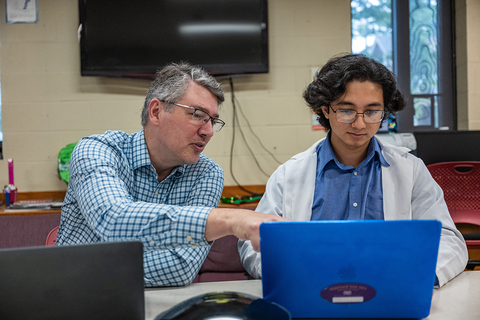
Energetic neutral atoms captured by these satellites are able to be mapped back to the magnetic field lines. Once the visual constructions are made, Younes explains, two different types of geomagnetic storms—Coronal Mass Ejections (CMEs) and Co-rotating Interaction Regions (CIRs)—can be compared.
Often it would take the pair days to resolve a problem, with no way to know how long it would take to complete, so strategic teamwork was essential.
“When it was more efficient to tackle problems separately, he [Wood] knew about that right away. When it was more efficient to solve them together, we could do so without getting in each other’s way,” Younes says.
But the biggest obstacle, by far, was figuring out a technical challenge of another kind. “A lot of the supplementary data was locked behind Dr. Wood’s old advisor’s code and files,” Younes says. “Dragging those out of their digital graves and making them usable was a huge time loss.”
Younes’ final takeaway from the SOAR experience was Wood’s expert coaching on how to clearly present his findings to an audience as he shared his research at the Landmark Symposium held at Juniata College and prepares to present during Moravian’s next Scholar’s Day.