
Jorge Velazquez ’25
Major: Cellular Neurobiology; Minor: Chemistry
Project: "Titanocene (III) Borohydride Catalyzed Reduction of Nitriles to Amines"
Advisor: Godfred Fianu, assistant professor of chemistry
Time-saving upgrades to the laboratory led cellular neurobiology major Jorge Velazquez to his SOAR project.
Past students seeking to reduce a species of molecules called nitriles into another species of molecules (amines) using a titanocene (III) borohydride-PMHS system mostly used an instrument for air sensitive chemistry called a Schlenk line.
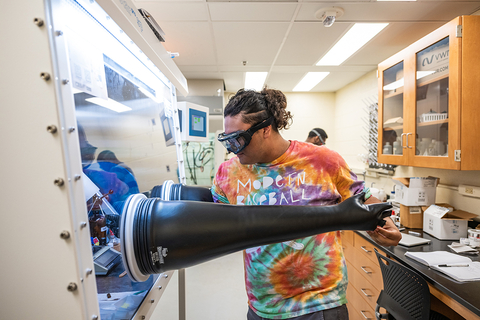
This time, Velazquez and his advisor, Godfred Fianu, assistant professor of chemistry used an instrument called a glove box, which was recently installed in the lab. “With the glove box, we were able to increase the scope and scale of the project, which would eventually turn into the SOAR project,” Velazquez says.
The Schlenk line is a glass apparatus that allows the user to vacuum out air from a special piece of glassware called a Schlenk flask. The user can then fill the flask with argon gas without exposing the contents inside to oxygen. This process took quite a while, Velazquez explains, because not only would he have to spend a lot of time preparing the Schlenk line to be filled with argon but he also had to be careful not to expose their reagents to oxygen. Preparing the titanocene (III) borohydride in the Schlenk line typically took several hours, he adds, and because of space limitations they could (at most) have four reactions running at the same time.
The glove box, on the other hand, is a giant box filled with argon gas and equipped with sensors to alert the user to oxygen leaks. In addition to being a lot easier to use, Velazquez says, the experiments generally ran a lot faster in the glove box. Instead of waiting hours for the titanocene (III) borohydride, the complex formed almost instantaneously. “This, of course, greatly expedited our efforts and allowed us to fit in more experiments in the short time we had during the summer.”
Velazquez’s project aimed to see if titanocene (III) borohydride and PMHS could reduce nitriles catalytically, he explains. “I was hoping for the reaction to be done in a fashion where each titanocene (III) borohydride complex could mediate the reduction of approximately 20 nitriles.” Velazquez found that while he could mediate nitrile reductions this way, it did not occur catalytically. “Instead, it operates as a sub-stoichiometric mediator, where each titanocene (III) borohydride complex could help mediate the reduction of approximately 5 nitriles.”
Velazquez hopes to present his research at Moravian’s Scholars Day and conferences in the future. He also plans to do an honors project with Joshua Lord, associate professor of biology, analyzing the effect of selective serotonin reuptake inhibitors (SSRIs) on shrimp behavior. “I learned that I really, really enjoy research. It is tremendously fun (despite the failures).”
This project was co-sponsored by the Office for Diversity, Equity, and Inclusion.